
Belongs within: Asiloidea.
The Apioceridae are a family of flower-feeding flies with a preference for sandy habitats. Their larvae, where known, are soil-dwelling carnivores (Peterson 1981).
Apiocera: flower-loving flies that don’t particularly care for flowers
Published 13 September 2019
The insect world is full of animals that may be striking in appearance but about which we know relatively little. Such, for instance, are the flies of the genus Apiocera.


Apiocera is a genus of a bit over 130 known species of relatively large flies, about half an inch to an inch in length, that are found in hot, arid habitats in disparate parts of the world: western North America, southern South America, southernmost Africa and Australia. Records of Apiocera from Borneo and Sri Lanka were regarded by Yeates and Irwin (1996) as probably errors. They are similar in their overall appearance to the robber flies of the family Asilidae, differing lacking the piercing mouthparts of robber flies or the moustache of bristles below the antennae. The venation of their wings is more similar to that of the mydas flies of the Mydidae, but they differ from most mydids in having shorter antennae and the regular triangle of three round ocelli on top of the head (Woodley 2009).
Observations of Apiocera species have been fairly few. A study of North American species by Toft & Kimsey (1982) found them to be restricted to sandy habitats with a fair amount of subsurface moisture, such as the shores of lakes and rivers or among sand dunes. The larvae, so far as we know, are similar to those of robber flies and are probably burrowing predators in the sand. Adults emerge from holes in the ground late in the growing season. In some places (such as Wikipedia), you may find Apiocera referred to as ‘flower-loving flies’ but visits to flowers are few. Toft & Kimsey (1982) found that the species they observed emerged after most plants had finished flowering and, indeed, questions have been raised historically as to whether adult Apiocera feed at all. Nevertheless, they may take honeydew from plant-sucking insects, and I will direct you to the photo below by Jean & Fred Hort that seems to show at least one Apiocera individual feeding at a flower. Males may congregate at certain locations, seemingly to form leks, though it is unclear whether they maintain territories. Toft & Kimsey (1982) noted that tussels between males of A. hispida were common, observing that “two males would make rapid contact in mid-flight, and stay together in a buzzing, tumbling ball for several seconds“.
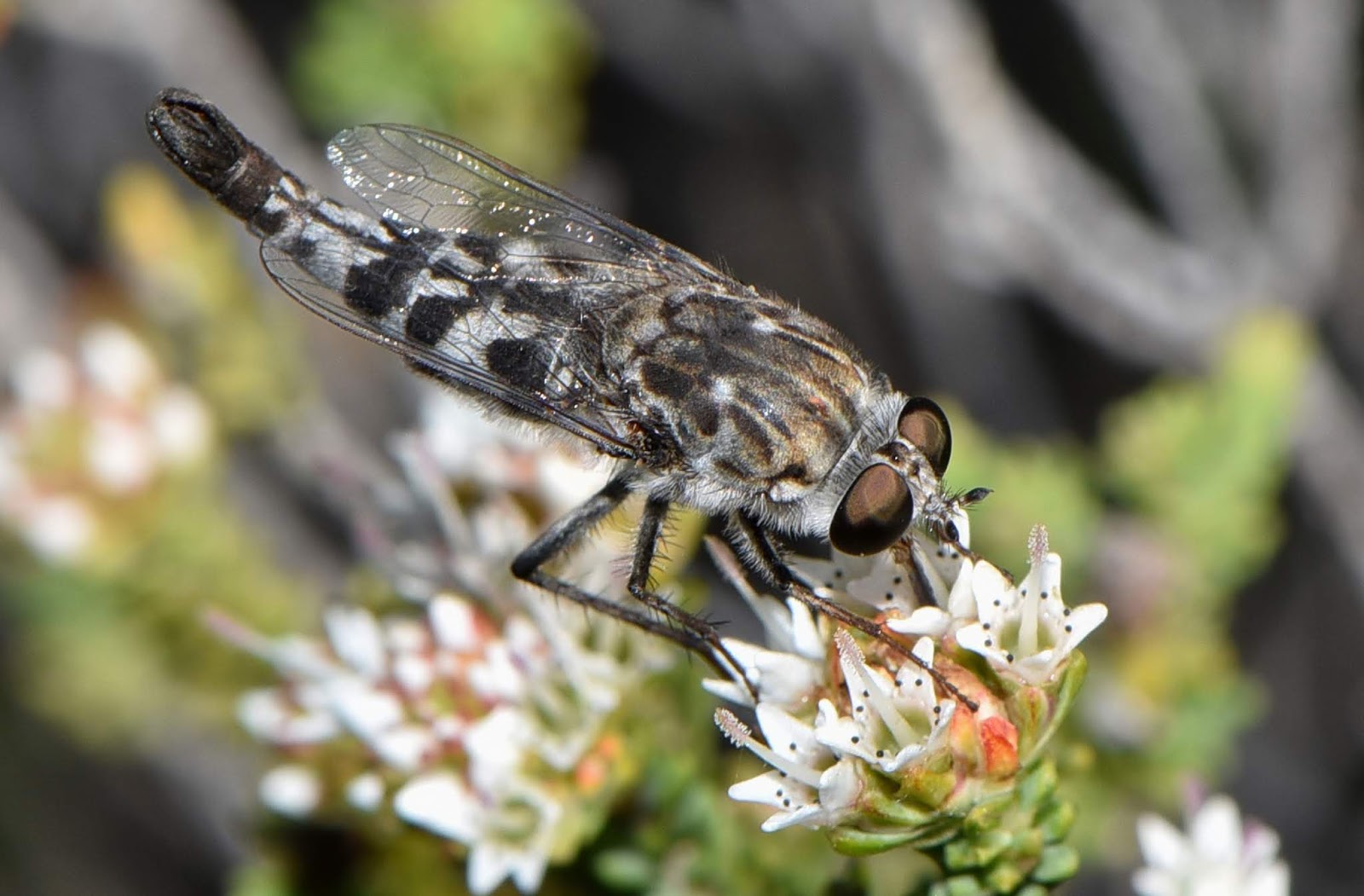
There seems to be little question that Apiocera and mydas flies are closely related. In fact, an analysis of Apiocera‘s phylogenetic relationships by Yeates & Irwin (1996) lead to a number of other genera that had previously been classified with Apiocera in the family Apioceridae being reassigned to the Mydidae (I suspect that it is the behaviour of these other ‘apiocerids’ that is behind the erroneous association of Apiocera with the ‘flower-loving’ moniker). Apioceridae is still maintained as a distinct family for Apiocera alone but, as noted by Woodley (2009), one could be forgiven for questioning whether Apiocera would be better treated as a very basal mydid. But that, of course, is simply a question of categories.
Systematics of Apioceridae
Characters (from Peterson 1981): Medium to large flies, 7.5-35.0 mm long, with most species ranging between 12.0 and 20.0 mm. Body stout, nearly bare to moderately setose, usually dull in color. Abdomen often elongate, tapering posteriorly; male terminalia often enlarged; tergite 10 of female with series of stout spines.
<==Apioceridae [Pomaceridae]
    |  i. s.: Protapiocera megista Ren 1998R98
    |--MegascelinaeP81
    |    |--Megascelus Philippi 1865P53
    |    |--Tongamya mirandaP81
    |    `--Neorhaphiomidas Norris 1936P81, P53 [=NeorhaphiomydasP53]
    |         |--N. pinguis Norris 1936P53
    |         `--+--*N. hardyi Norris 1936P53
    |            |--N. norrisi Paramonov 1953P53
    |            |--N. pallida Paramonov 1953P53
    |            |--N. setosa Paramonov 1953P53
    |            `--N. villosa Paramonov 1953P53
    `--Apiocera Westwood 1835P53 (see below for synonymy)
         |  i. s.: A. fuscicollis Westwood 1835 (n. d.)P53
         |         A. haruspexP81
         |         A. painteriP81
         |         A. (Pyrocera)W09
         |           |--A. (P.) barriW09
         |           |--A. (P.) clavatorW09
         |           |--A. (P.) lavigneiW09
         |           `--A. (P.) mexicanaW09
         |--A. immedia Hardy 1940P53
         |--A. ferruginea groupP53
         |    |--A. ferruginea Paramonov 1953P53
         |    `--A. vulpes Hermann 1909P53
         |--A. striativentris groupP53
         |    |--A. lugubris Paramonov 1953P53
         |    `--A. striativentris Paramonov 1953P53
         |--A. maritima groupP53
         |    |--A. excepta Paramonov 1953P53
         |    |--A. maritima Hardy 1933P53
         |    `--A. pallida Norris 1936P53
         |--A. omniflava groupP53
         |    |--A. afacialis Paramonov 1953P53
         |    |--A. deserticola Paramonov 1953P53
         |    |--A. latipennis Paramonov 1953P53
         |    |--A. omniflava Paramonov 1953P53
         |    `--A. ordana Paramonov 1953P53
         |--A. latifrons groupP53
         |    |--A. angusta Paramonov 1953P53
         |    |--A. contrasta Paramonov 1953P53
         |    |--A. latifrons Paramonov 1953P53
         |    |--A. tropica Paramonov 1953P53
         |    `--A. unicolor Paramonov 1953P53
         |--A. minor groupP53
         |    |--A. australis Paramonov 1953P53
         |    |--A. mackerrasi Paramonov 1953P53
         |    |--A. minor Norris 1936P53
         |    |--A. newmani Norris 1936P53
         |    `--A. vespera Paramonov 1953P53
         |--A. hardyi groupP53
         |    |--A. fullerae Paramonov 1953P53
         |    |--A. hardyi Paramonov 1953P53
         |    |    |--A. h. hardyiP53
         |    |    `--A. h. angustifrons Paramonov 1953P53
         |    `--A. nicholsoni Paramonov 1953P53
         |--A. deforma groupP53
         |    |--A. deforma Norris 1936P53
         |    |--A. elegans Paramonov 1953P53
         |    |--A. goerlingi Paramonov 1953P53
         |    |--A. helenae Paramonov 1953P53
         |    |--A. maxima Paramonov 1953P53
         |    `--A. pulchra Paramonov 1953P53
         |--A. tonnoiri groupP53
         |    |--A. campbelli Paramonov 1953P53
         |    |--A. flabellata Paramonov 1953P53
         |    |--A. imminuta Hardy 1940P53
         |    |--A. norrisi Hardy 1940P53
         |    |--A. norrisiana Paramonov 1953P53
         |    |--A. oblonga Paramonov 1953P53
         |    `--A. tonnoiri Norris 1936P53
         |--A. asilica groupP53
         |    |--*A. (Apiocera) asilica Westwood 1835P53
         |    |--A. antennata Paramonov 1953P53
         |    |--A. basivillosa Paramonov 1953P53
         |    |--A. commoni Paramonov 1953P53
         |    |--A. fasciata Paramonov 1953P53
         |    |--A. moerens Westwood 1841P53 [=A. maerens (l. c.)O98]
         |    |--A. orientalis Paramonov 1953P53
         |    |--A. ornata Paramonov 1953P53
         |    |--A. pica Norris 1936P53
         |    |--A. pilosoris Paramonov 1953P53
         |    |--A. septentrionalis Paramonov 1953P53
         |    `--A. swani Paramonov 1953P53
         `--A. brevicornis groupP53
              |--A. acutipalpis Paramonov 1953P53
              |--A. albanyana Paramonov 1953P53
              |--A. aliena Paramonov 1953P53
              |--A. asiloides Paramonov 1953P53
              |--A. bigoti Macquart 1847P53
              |--A. brevicornis (Wiedemann 1830)P53 [=Laphria brevicornisP81, *Tapinocera brevicornisP53]
              |--A. englishae Paramonov 1953P53
              |--A. longitudinalis Paramonov 1953P53
              |--A. moderata Paramonov 1953P53
              |--A. picoides Paramonov 1953P53
              |--A. reginae Paramonov 1953P53
              |--A. similis Paramonov 1953P53
              `--A. victoriae Paramonov 1953P53
Apiocera Westwood 1835P53 [incl. AnypenusP53, Pomacera Macquart 1847P53, Rhipidosyrma Hermann 1909P53, Tapinocera Macquart 1838P53; ApiocerinaeP81]
*Type species of generic name indicated
References
[O98] Oosterbroek, P. 1998. The Families of Diptera of the Malay Archipelago. Brill: Leiden.
[P53] Paramonov, S. J. 1953. A review of Australian Apioceridae (Diptera). Australian Journal of Zoology 1 (3): 449–536.
[P81] Peterson, B. V. 1981. Apioceridae. In: McAlpine, J. F., B. V. Peterson, G. E. Shewell, H. J. Teskey, J. R. Vockeroth & D. S. Wood (eds) Manual of Nearctic Diptera vol. 1 pp. 541–548. Research Branch, Agriculture Canada.
Toft, C. A., & L. S. Kimsey. 1982. Habitat and behavior of selected Apiocera and Rhaphiomidas (Diptera, Apioceridae), and descriptions of immature stages of A. hispida. Journal of the Kansas Entomological Society 55 (1): 177–186.
[W09] Woodley, N. E. 2009. Apioceridae (apiocerid flies). In: Brown, B. V., A. Borkent, J. M. Cumming, D. M. Wood, N. E. Woodley & M. A. Zumbado (eds) Manual of Central American Diptera vol. 1 pp. 577–578. NRC Research Press: Ottawa.
Yeates, D. K., & M. E. Irwin. 1996. Apioceridae (Insecta: Diptera): cladistic reappraisal and biogeography. Zoological Journal of the Linnean Society 116: 247–301.