Belongs within: Nymphalidae.
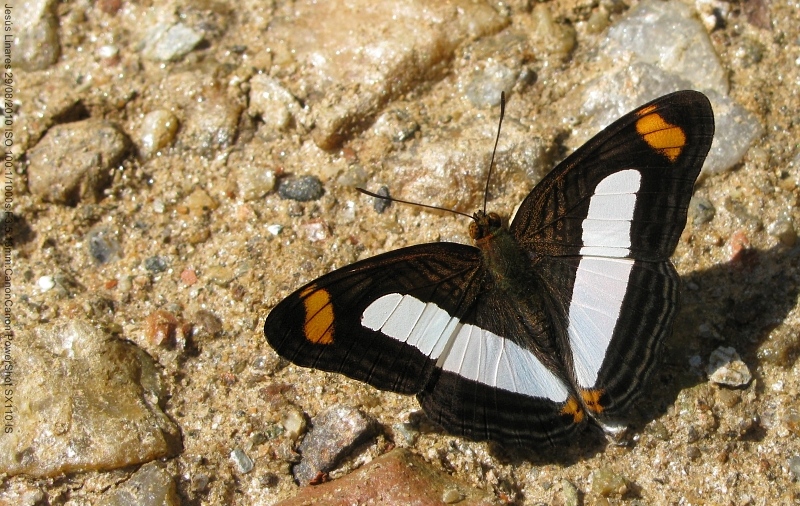
Adelpha, the sisters, is a New World genus of butterflies with wings that are primarily dark brown above and black below, usually with lighter postdiscal stripes.
Deceptive and poisonous sisters
Published 25 September 2012
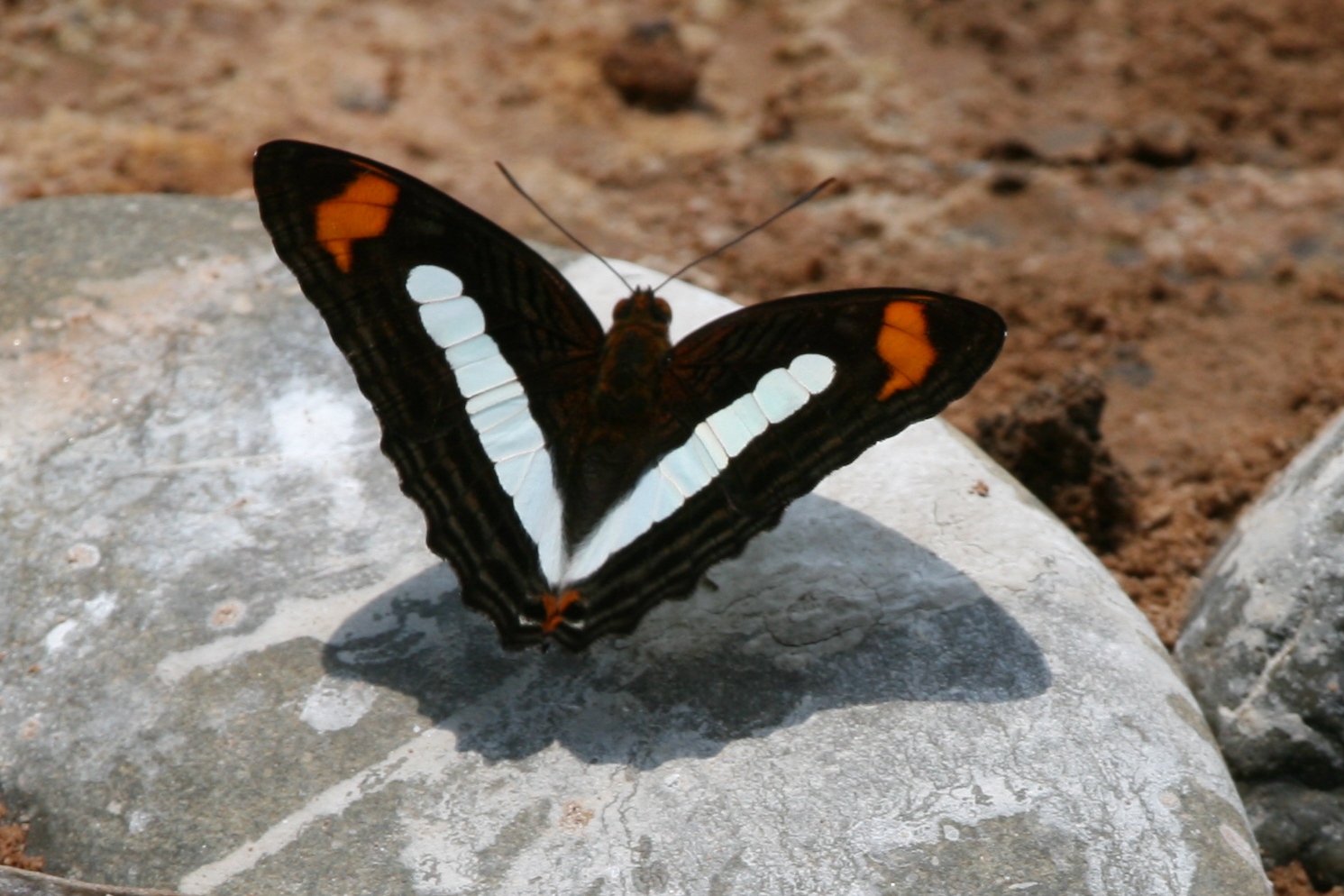
The butterfly genus Adelpha includes 85 species, many with multiple subspecies, found widely in North and South America (Willmott 2003a). Some of you may recognise ‘adelpha’ as the Greek word for ‘sister’, which is also the vernacular name for these butterflies. Supposedly, the white stripes on the wings of many species resemble the edges of a nun’s habit (or, at least, so sayeth Wikipedia). The sisters belong to a group of butterflies called the Limenitidini, members of which tend to sit with their wings open when resting, and have a distinctive gliding flight pattern in which the wing tips are pointed downwards (Willmott 2003b). Adelpha is the only genus of Limenitidini found in South America. In North America, Adelpha bredowii is found as far north as Oregon, while in South America species are found down to Uruguay. Not surprisingly, the highest diversity is found in the tropics, though some species are relatively uncommon throughout their ranges (Willmott 2003a).
As caterpillars, Adelpha species feed on a wide variety of food plants, with individual species varying from very host-specific species to broadly catholic species. As befits Neotropical caterpillars, some species possess a ludicrous array of protrusions and outgrowths:

When feeding on a leaf, the caterpillars leave the midrib intact, and use it as a support when resting. Over time, they extend the midrib using a combination of faecal pellets and silk to extend their support, and they also sit on this support when moulting. After moulting to the final larval instar, they leave the support and rest on the upper leaf surface. They also attach masses of mixed silk and faecal pellets to the base of their support or hanging off it. One species, Adelpha basiloides, builds small, curved, larva-shaped faecal masses that it places on the leaf surface several millimetres away from its support: Aiello (1984) speculated that these might functions as decoys to distract potential predators from the real caterpillar.

The adults of Adelpha have a reputation for being tricky to identify; DeVries described them as “the most difficult and trying taxonomically of all the nymphalids”. For a long time, Adelpha species were divided into groups on the basis of their wing patterning, but comparisons with other features such as caterpillar morphology have revealed that species with similar wing patterns are often not closely related (Aiello 1984; Willmott 2003b). Instead, it has been suggested that mimicry has been a significant factor in the genus’ evolution: certain species feeding as caterpillars on toxic plants such as members of the Rubiaceae (and hence sequestering the plant toxins to render themselves distasteful) are imitated by species with more innocuous diets. Because the appropriate model for such mimicry may vary with distribution, some mimetic species are quite variable in appearance; prior to the genus’ revision by Willmott (2003a), some members of a single species were classified in entirely separate species groups!
Systematics of Adelpha
Characters (from Willmott 2003a): Medium to large butterflies with essentially sexually monomorphic wing patterns, consisting of contrasting ventral and dorsal surfaces. Dorsal surface always with a dark brown ground colour and almost always a postdiscal band on one or both wings, which may be vertical or oblique, and orange, white, or red in colour; postdiscal series usually fused on the dorsal surface of the forewing to form a subapical marking. Ventral surface typically with a black ground colour which is usually obscured by much reddish brown colouring, and in addition to the postdiscal bands that appear on the dorsal surface it has a number of lighter postdiscal and submarginal lines and other more basal pattern elements; dark brown longitudinal line usually present on the hindwing ventral surface extending from the base of cell 3A-2A to the middle of the anal margin in this cell, though this line may be fused to a band of colour that fills the anterior half of the cell, or broken in the basal half of the wing; venal stripe usually present at vein 3A on the ventral hindwing, may be split along the vein into two halves and variously modified or reduced.
<==Adelpha
    |--A. bredowiP72
    |--A. cythereaS55
    |    |--A. c. cythereaS55
    |    `--A. c. lanilla Fruhstorfer 1915S55
    |--A. erotia (Hewitson 1847)S55
    |--A. iphiclaS55
    |    |--A. i. iphiclaS55
    |    `--A. i. pharae Fruhstorfer 1915S55
    |--A. laraS55
    |    |--A. l. laraS55
    |    `--A. l. mainas Fruhstorfer 1915S55
    `--A. mesentina (Cramer 1779)S55
*Type species of generic name indicated
References
Aiello, A. 1984. Adelpha (Nymphalidae): deception on the wing. Psyche 91 :1–46.
[P72] Powell, J. A. 1972. Mass movements of Nymphalis californica (Boisduval) in the San Francisco Bay area during 1971 (Lepidoptera: Nymphalidae). Pan-Pacific Entomologist 48 (2): 144.
[S55] Schröder, H. 1955. Eine Falter-Ausbeute aus dem westlichen Bolivien. (Ins. Lepid. Rhopal.) Senckenbergiana Biologica 36: 329–338.
Willmott, K. R. 2003a. The Genus Adelpha: Its systematics, biology and biogeography (Lepidoptera: Nymphalidae: Limenitidini). Scientific Publishers.
Wilmott, K. R. 2003b. Cladistic analysis of the Neotropical butterfly genus Adelpha (Lepidoptera: Nymphalidae), with comments on the subtribal classification of Limenitidini. Systematic Entomology 28: 279–322.