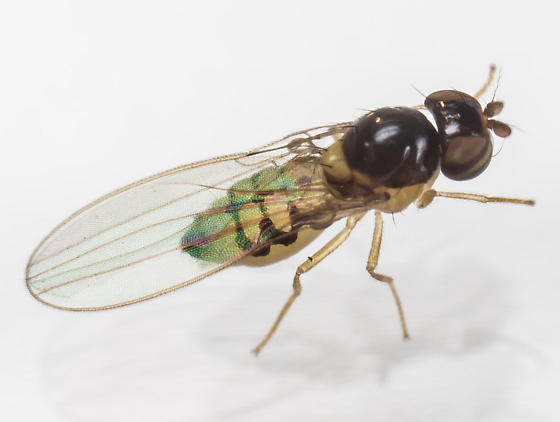
Belongs within: Schizophora.
The Asteiidae are a cosmopolitan but little-studied group of small, generally soft-bodied flies. Most species (placed in the subfamily Asteiinae) have wings with vein R2+3 relatively short, reaching the costa at about the middle of the wing, but the Holarctic genus Leiomyza has this vein longer and reaching the costa about the distal quarter of the wing. Members of the Asteiinae may be divided between the tribes Sigaloessini, in which wings possess both crossvein dm-cu and an alula, and Asteiini, in which both these features are absent (Freidberg 2010). Loewimyia lacks both an antennal arista and enlarged fronto-orbital setae (Freidberg 2010).
The asteiids: overlooked flies
Published 13 June 2017
Flies are incredibly diverse, but they may be one of the least appreciated of the major insect groups. There are many significant fly lineages whose presence goes all but unnoticed by a small number of afficionados.

One of the largest clades of flies is the Schizophora, including many such familiar animals as house flies, blowflies, and fruit flies (of both varieties). The most distinctive feature marking this lineage is the ptilinal fold, a groove that runs around the face of the flies along the inner margin of the eyes and across above the antennal insertions. This groove marks the position of a large fold of soft cuticle, the ptilinum, that is used by the fly when it emerges from the hardened case, the puparium, in which it metamorphoses from a larva. The ptilinum expands like a bellows as the fly pumps its head full of liquid until the pressure causes the cap of the puparium to pop open. After this, the excess cuticle is folded away inside the head, never to emerge again, but the mark of its presence remains.

Schizophorans have commonly been divided between two main groups, referred to as the calyptrates and acalyptrates. The basis of this division is the presence (calyptrates) or absence (acalyptrates) of the calypters, lobes at the base of the wings that help in controlling flight. This is not an entirely phylogenetic system: the calyptrates are a single clade but the acalyptrates are not. The most familiar flies belong to the calyptrates (which include house flies and blowflies) despite the fact that acalyptrate flies are considerably more diverse. This is in part because many acalyptrates are very small flies, easily overlooked by the casual observer.
The Asteiidae are one such group of overlooked flies. They are found pretty much world-wide and can be very abundant in some habitats. Nevertheless, they are apparently not common in collections: their soft-bodiedness makes them tricky to preserve, and Grimaldi (2009) noted that tropical species living on rolled leaves of herbs such as bananas and gingers were reluctant fliers and so unlikely to be collected by passive intercept traps. Noteworthy features of asteiids compared to similar flies include a reduced wing venation, and an antennal arista bearing alternating rays (Friedberg 2010). In two genera, Polyarista and Anarista, the arista is reduced or lacking, replaced by a collection of long setae arising from the first flagellomere (Papp 2013).


Because of their low collection rates, the natural history of asteiids is poorly known. As already noted, a number of species are found in association with vegetation; others have been raised from fungi. Grimaldi (2009) described Asteia species running “over the surface of a leaf in all directions with uniform effort, including backwards and sideways, which gives them an appearance of floating over the surface“. Some species have mating rituals involving trophallaxis, in which a male attempts to entice a female by offering her a regurgitated droplet. If his offering meets her standards, they will collaborate to produce a new generation that will carry on in the same obscurity as the last.
Systematics of Asteiidae
Characters (from Freidberg 2010): Small (body length 1–5 mm), winged, generally weakly sclerotised flies. Coloration varying from predominantly yellow to predominantly black, but more or less elaborate and contrasting pattern usually present on some or all major body parts. Head rectangular to oval in lateral view, with zero to two short to long fronto-orbital seta. Antenna short, with first flagellomere usually rounded. Arista usually well developed, with short to long alternating rays (microtrichia), occasionally reduced or absent. Proboscis short, with fleshy labella. Males with interfrontal stripes. Thorax with one to four dorsocentral setae; when four then anterior dorsocentral seta presutural. Scutellum short, convex, usually with two pairs of setae, basal seta much shorter than apical seta or absent. Acrostichal setulae zero to two rows, without setae. Pleura without setae; anepisternum sometimes with setulae. Legs without overt features. Wing usually elongate, covering abdomen and extending beyond it when at rest. Vein R2+3 short, ending at tip of vein R1 or slightly more distally except in Leiomyza, in which it reaches distal 0.75 of wing. Vein M1 concave anteriorly, distally convergent with vein R4+5. Crossvein dm-cu present or absent. Alula bare or with marginal cilia. Abdomen with weakly sclerotised tergites except in Leiomyza. Spiracles two to six situated in tergites; spiracle seven absent. Male terminalia symmetric in Leiomyza, asymmetric in most other taxa. Surstylus fused with epandrium. Phallus usually large and heavily sclerotised. Female terminalia simple, segment 7 sometimes developed as an incomplete oviscape. Two sclerotised spermathecae present.
<==AsteiidaeF10
    |  i. s.: Astiosoma flaveolumS87
    |         Succinasteia carpenteriS87
    |         Bahamia longicepsS87
    |--Leiomyza Macquart 1835C-T92 [LeiomyzinaeF10]
    |    |--L. dudai Sabrosky 1956C-T92
    |    |--L. laevigata (Meigen 1830)C-T92
    |    `--L. nitidulaCM91
    `--Asteiinae [Asteinae]F10
         |--AsteiiniF10
         |    |--Loewimyia bifurcataF10
         |    `--Asteia [incl. Asteimyia]F10
         |         |--A. (Asteia) amoena Meigen 1830C-T92
         |         |--A. antennata [=Asteimyia antennata]F10
         |         |--A. beataF10
         |         |--A. palikuensisO98
         |         `--A. spinosa [=Asteimyia spinosa]F10
         `--SigaloessiniF10
              |--AnaristaF10
              |--Tucumyia liniarisF10
              |--SigaloessaF10 [incl. CrepidohammaCM70]
              |    `--S. bicolorF10
              `--PhlebosoteraF10
                   |--P. setipalpisF10
                   `--P. shewelliS87
*Type species of generic name indicated
References
[C-T92] Carles-Tolrá, M. 1992. New and interesting records of Diptera Acalyptrata from Spain. Part I: Acartophthalmidae, Opomyzidae, Anthomyzidae, Asteiidae, Carnidae, Tethinidae, Milichiidae and Cryptochetidae. Bull. Annls Soc. R. Belge Ent. 128: 343–353.
[CM70] Colless, D. H., & D. K. McAlpine. 1970. Diptera (flies). In: CSIRO. The Insects of Australia: A textbook for students and research workers pp. 656–740. Melbourne University Press.
[CM91] Colless, D. H., & D. K. McAlpine. 1991. Diptera (flies). In: CSIRO. The Insects of Australia: A textbook for students and research workers 2nd ed. vol. 2 pp. 717–786. Melbourne University Press: Carlton (Victoria).
[F10] Freidberg, A. 2010. Asteiidae (asteiid flies). In: Brown, B. V., A. Borkent, J. M. Cumming, D. M. Wood, N. E. Woodley & M. A. Zumbado (eds) Manual of Central American Diptera vol. 2 pp. 1093–1096. NRC Research Press: Ottawa.
Grimaldi, D. A. 2009. The Asteioinea of Fiji (Insecta: Diptera: Periscelididae, Asteiidae, Xenasteiidae). American Museum Novitates 3671: 59 pp.
[O98] Oosterbroek, P. 1998. The Families of Diptera of the Malay Archipelago. Brill: Leiden.
Papp, L. 2013. A new genus of Asteiidae with a key to the Old World genera (Diptera). Annales Historico-Naturales Musei Nationalis Hungarici 105: 199–205.
[S87] Sabrosky, C. W. 1987. Asteiidae. In: McAlpine, J. F. (ed.) Manual of Nearctic Diptera vol. 2 pp. 899–902. Research Branch, Agriculture Canada.