Belongs within: Euungulata.
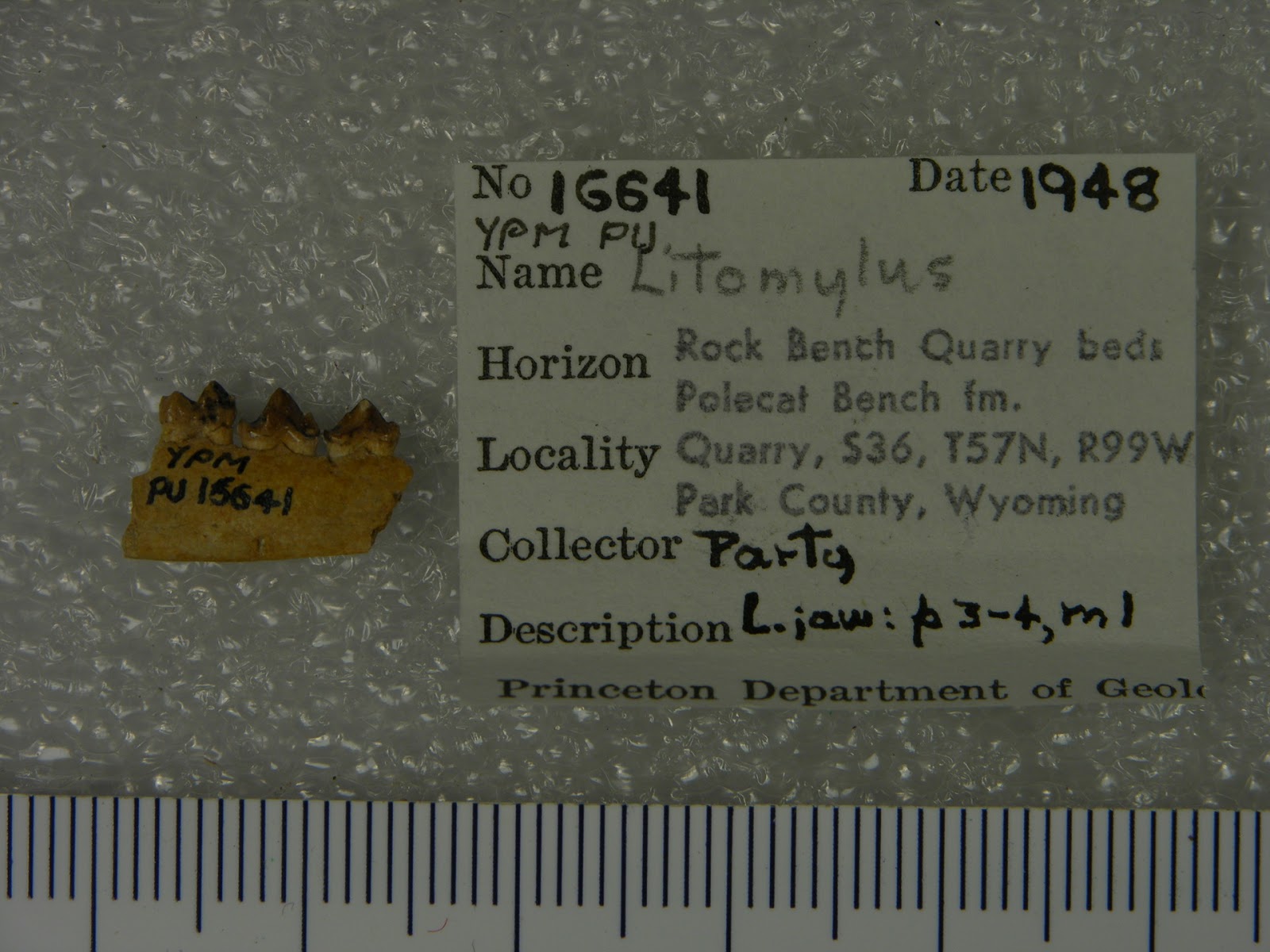
The Hyopsodontidae are a group of small, generalised mammals known from the Palaeocene and Eocene of Europe and North America. Members of this group have fairly simple incisors and premolars, small canines, and more or less bunodont molars.
Hyopsodontids: little slingers of the Palaeogene
Published 2 October 2017
The oft-repeated quote about mammalian palaeontology is that it tends to be focused on “the tooth, the whole tooth, and nothing but the tooth”. This is primarily the result of pragmatic constraints: because they are much harder than the other bones of the mammalian skeleton, teeth are much more likely to be preserved in the fossil record. There are a great many fossil mammals for which the teeth remain pretty much the only part of the animal known. However, there is no question that this focus tends to limit our understanding of mammalian evolution. On the one hand, the complex morphology of many mammalian teeth means that they provide a wealth of characters for analysis. On the other, the morphology of teeth is heavily influenced by their bearer’s diet and lifestyle, meaning that phylogenetically informative features are probably outweighed by the products of ecological convergence.

All of which is pretty important background to keep in mind for any discussion of the Hyopsodontidae, a group of small (mostly rat- or weasel-sized) mammals recognised from the Palaeogene, the early part (Palaeocene and Eocene epochs) of the Caenozoic era. Hyopsodontids are generally assigned to the ‘Condylarthra’, a group of mammals that has long been recognised as one of the classic examples of a ‘wastebasket taxon’. Condylarths were originally united as primitive relatives of the ungulates, the hoofed mammals. However, the individual condylarth families themselves have not got much in common otherwise, and (particularly with the current acceptance that ‘ungulates’ are probably not a monophyletic group) it is hard to come up with a definition for ‘condylarths’ that amounts to much more than ‘medium-sized, unspecialised Palaeogene placentals’.
The hyopsodontids have been recognised as one of the longest-lived groups of ‘condylarths’, with assigned members extending from close to the start of the Palaeocene right up to near the end of the Eocene. Here again, though, we come up against the question of definition. The majority of taxa that have been aligned with the hyopsodontids are among those known only from teeth. Features of the hyopsodontid dentition include fairly simple incisors and premolars, small canines, and molars that are more or less bunodont (that is, the cusps are rounded or conical and clearly separate from each other rather than being connected by lophs). The problem is that these are all primitive, unspecialised features. Hyopsodontids are therefore defined more by their lack of alternate specialisations than anything positive, making them something of a wastebasket within a wastebasket.
Until recently, the only hyopsodontid known from much in the way of postcranial material was the type genus Hyopsodus, a number of species of which are known from an extended period of the Eocene. Indeed, Hyopsodus was one of the most abundant mammalian genera of its time, accounting for over a quarter of mammalian remains in a number of deposits where it is found (Rose 2006). These remains combine to give a picture of Hyopsodus as a long, low-bodied animal that has been compared in its proportions to a dachshund, a weasel, or a prairie dog. Hyopsodus would have been a ground-hugging slinker of an animal, build for concealment rather than speed. Short claws on the forelegs may be consistent with a certain degree of digging ability, whether in search of buried tubers or to scrape shallow burrows. Overall, Hyopsodus was probably a generalist, able to make a living wherever it may find itself: the real rat of the Eocene.
It was only relatively recently that Penkrot et al. (2008) provided further descriptions of limb-bone material from two other genera associated with the hyopsodontids, Apheliscus and Haplomylus. And despite the dental similarities between these genera and Hyopsodus, their postcranial anatomy indicates a quite different animal. Though small, the apheliscines were relatively long-legged, speedy runners: sprinters rather than slinkers. Penkrot et al. interpreted the apheliscines as relatives of the modern elephant shrews of Africa; whether or not there was a valid phylogenetic connection, the two would have certainly been ecologically similar.
Both Hyopsodus and Apheliscus were included in the broad-scale analysis of early placental phylogeny by Halliday et al. (2017). The results of the analysis corroborate the implications of the postcranial anatomy: despite dental similarities, the ‘hyopsodontids’ in the broad sense are not a monophyletic group. Over a dozen other genera are known of candidate hyopsodontids, but so long as they are known only from dental characters their true position remains uncertain. Without postcranial data, it seems, we can’t handle the tooth.
Systematics of Hyopsodontidae
Hyopsodontidae [Hyopsodidae]
    |--LouisininaeR06
    |    |--LouisinaR06
    |    `--MonshyusR06
    `--TricuspiodontinaeSFY02
         |--Tricuspiodon Lemoine 1885V66
         `--Litomylus Simpson 1935SFY02
              |--*L. dissentaneus Simpson 1935SFY02
              |--L. grandaletes Scott, Fox & Youzwyshyn 2002SFY02
              |--L. ishami Gazin 1956SFY02
              |--L. orthronepius Johnston & Fox 1984SFY02
              |--L. osceolae Van Valen 1978SFY02
              `--L. scaphicus Gazin 1956SFY02

Hyopsodontidae incertae sedis:
  Pascatherium Russell 1964N85, V67
    `--P. dolloi (Teilhard de Chardin 1927)M60 [=Adapisorex dolloiV67]
  Haplaletes Simpson 1935S35
    `--*H. disceptatrix Simpson 1935S35
  Hyopsodus Leidy 1870D07
    |--*H. paulusC77
    |--H. browniG52
    |--H. despiciensD07
    |--H. egressusHUG17
    |--H. fastigatus Russell in Russell & Wickenden 1933S96
    |--H. gracilisD07
    |--H. lepidusD07
    |--H. loomisiD07
    |--H. markmaniSP96
    |--H. marshiD07
    |--H. mentalis (Cope 1875)G52, C77 (see below for synonymy)
    |    |--H. m. mentalisG52
    |    `--H. m. lysitensisG52
    |--H. minisculusD07
    |--H. miticulus (Cope 1874) [=Esthonyx miticulus]C77
    |--H. powellianusG52
    |--H. simplexG52
    |--H. vicariusC77
    |--H. wardiD07
    `--H. wortmaniD07
  Aletodon Gingerich 1977SFY02
    `--A. quadravusSFY02
  Heptaconodon Zdansky 1930SM93
  PaschatheriumR06
Hyopsodus mentalis (Cope 1875)G52, C77 [=Antiacodon mentalisG52, Sarcolemur mentalisC77; incl. Hyopsodus lemoinianusG52]
*Type species of generic name indicated
References
[C77] Cope, E. D. 1877. Report upon the extinct Vertebrata obtained in New Mexico by parties of the expedition of 1874. Geographical Surveys West of the One Hundredth Meridian 4 (2): i–iv, 1–370.
[D07] Dixon, D. 2007. The Complete Illustrated Encyclopedia of Dinosaurs & Prehistoric Creatures. Hermes House: London.
[G52] Gazin, C. L. 1952. The Lower Eocene Knight Formation of western Wyoming and its mammalian faunas. Smithsonian Miscellaneous Collections 117 (18): 1–82, 11 pls.
[HUG17] Halliday, T. J. D., P. Upchurch & A. Goswami. 2017. Resolving the relationships of Paleocene placental mammals. Biological Reviews 92 (1): 521–550.
[N85] Novacek, M. J. 1985. The Sespedectinae, a new subfamily of hedgehog-like insectivores. American Museum Novitates 2822: 1–24.
Penkrot, T. A., S. P. Zack, K. D. Rose & J. I. Bloch. 2008. Postcranial morphology of Apheliscus and Haplomylus (Condylarthra, Apheliscidae): evidence for a Paleocene Holarctic origin of Macroscelidea. In: Sargis, E. J., & M. Dagosto (eds) Mammalian Evolutionary Morphology: A Tribute to Frederick S. Szalay pp. 73–106. Springer.
[R06] Rose, K. D. 2006. The Beginning of the Age of Mammals. John Hopkins University Press: Baltimore.
[SFY02] Scott, C. S., R. C. Fox & G. P. Youzwyshyn. 2002. New earliest Tiffanian (late Paleocene) mammals from Cochrane 2, southwestern Alberta, Canada. Acta Palaeontologica Polonica 47: 691–704.
[S35] Simpson, G. G. 1935. New Paleocene mammals from the Fort Union of Montana. Proceedings of the United States National Museum 83 (2981): 221–244.
[S96] Storer, J. E. 1996. Eocene-Oligocene faunas of the Cypress Hills Formation, Saskatchewan. In: Prothero, D. R., & R. J. Emry (eds) The Terrestrial Eocene–Oligocene Transition in North America pp. 240–261. Cambridge University Press.
[SM93] Stucky, R. K., & M. C. McKenna. 1993. Mammalia. In: Benton, M. J. (ed.) The Fossil Record 2 pp. 739–771. Chapman & Hall: London.
[SP96] Stucky, R. K., D. R. Prothero, W. G. Lohr & J. R. Snyder. 1996. Magnetic stratigraphy, sedimentology, and mammalian faunas of the Early Uintan Washakie Formation, Sand Wash Bain, northwestern Colorado. In: Prothero, D. R., & R. J. Emry (eds) The Terrestrial Eocene–Oligocene Transition in North America pp. 40–51. Cambridge University Press.
[V66] Van Valen, L. 1966. Deltatheridia, a new order of mammals. Bulletin of the American Museum of Natural History 132 (1): 1–126.
[V67] Van Valen, L. 1967. New Paleocene insectivores and insectivore classification. Bulletin of the American Museum of Natural History 135 (5): 217–284.