

Belongs within: Carnivora.
The Otarioidea are the eared seals, the clade containing fur seals, sea lions and walruses. Eared seals differ from their sister group, the true seals, in retaining visible ear flaps, and being able to bring the hind flippers forward underneath the body for walking on land. Otarioids have a homodont dentition except in the basal Enaliarctos (Repenning 1976). Living otarioids are divided between two families, of which the Odobenidae includes a single living species, the walrus Odobenus rosmarus, a large molluscivore found in Arctic and sub-Arctic regions of the North Hemisphere.
Walruses, sea lions and fur seals
Published 15 February 2018
Adaptation to a primarily aquatic lifestyle has happened numerous times within mammals, but some groups have radiated more in this environment than others. One particularly well-known group of marine mammals is the pinnipeds, the seals and sea lions.


Pinnipeds are highly modified for life in the water, with streamlined bodies and all four limbs modified into flippers. When I was young, many of the animal books that I read referred to pinnipeds as their own distinct order within the mammals. However, it has long been recognised that pinnipeds are derived from within the Carnivora and these days they are almost universally treated as a subgroup of the latter. Modern pinnipeds are divided between three families: the Phocidae (‘true’ seals), Otariidae (fur seals and sea lions) and Odobenidae (which has only one living species, the walrus Odobenus rosmarus). While some morphological analyses have argued for a relationship between the walrus and the Phocidae, the majority view treats the walrus and the Otariidae as together forming a clade Otarioidea, commonly referred to as the eared seals. There has historically also been some argument about whether the pinnipeds represent a single clade; some have argued for two separate origins, Otarioidea being related to bears whereas Phocidae were supposed to be closer to otters and weasels. However, the current majority supports a single origin for the group.


Eared seals differ from true seals in the possession of small external ears, and the ability to turn the hind flippers back under the body so that they can still function (if somewhat awkwardly) as feet when moving on land. I have seen Australian sea lions on coastal islands near Perth (there are boat tours that will take you to see them) and I can confirm that they can run along the beach at a surprising speed when they wish to. True seals have the hind flippers permanently directed behind them and so are forced to awkwardly belly-flop along when not swimming (doubtless as a result of this, true seals also differ from eared seals in that males lack an external scrotum). In the water, the hind flippers provide the main source of propulsion in true seals whereas eared seals get more of their thrust from the fore flippers (sea lions have been said to swim like penguins). As an aside, eared seals are also apparently unusual among mammals in that their milk completely lacks lactose. The lactose intolerant among you need not be denied dairy, you need only milk a walrus.


The earliest eared seals are known from the Miocene when they appear to have originated in the northern Pacific. Two extinct families from this place and period, the Enaliarctidae and Desmatophocidae, are commonly included in the Otarioidea, though it remains possible that either of these families should be placed outside the pinniped crown group, or closer to the true seals. The early Miocene Enaliarctidae differ from other otarioids in retaining differentiated premolars and molars (later forms have the cheek teeth uniform in appearance) and may well represent the ancestral form of the group. The mid- to late Miocene Desmatophocidae combined a rather Phocidae-like skull with a more Otarioidea-like post-cranium; the best-known genus Allodesmus had larger eyes than other otarioids and may have hunted in deep waters. One species of desmatophocid, Allodesmus sinanoensis, may have reached a length approaching five metres, making it larger than a modern walrus and rivalling the elephant seals in size. I highly recommend a series of posts on Allodesmus written a few years back by Robert Boessenecker (1, 2, 3, 4) that cover just about everything you might want to know about this animal.

Though only one walrus species is generally recognised in the modern fauna, the family was much more diverse in the past. However, most fossil Odobenidae lacked the tusks of a modern walrus and would have been more similar at a glance to sea lions. These early odobenids would have probably been generalist fish-feeders (Boessenecker & Churchill 2013). The modern walrus, in contrast, feeds primarily on bivalves. They don’t crush the clam’s shell but grab it with their lips and then suck powerfully enough that the meat is ripped out. Other than the tusks, the teeth of a modern walrus are small and weak; one close fossil relative, the Pliocene Valenictus chulavistensis, went so far as to lose the non-tusk teeth entirely. The tusks themselves are usually thought to function in display and the like rather than having any prominent role in feeding. However, it is an intriguing detail that the fossil whale Odobenocetops that converged in its feeding biology with walruses also possessed a large tusk. The non-tusk teeth were still used in feeding in the fossil clam-feeding walrus genera Dusignathus and Gomphotaria, which had a pair of large forward-directed tusks in both the upper and lower jaws.
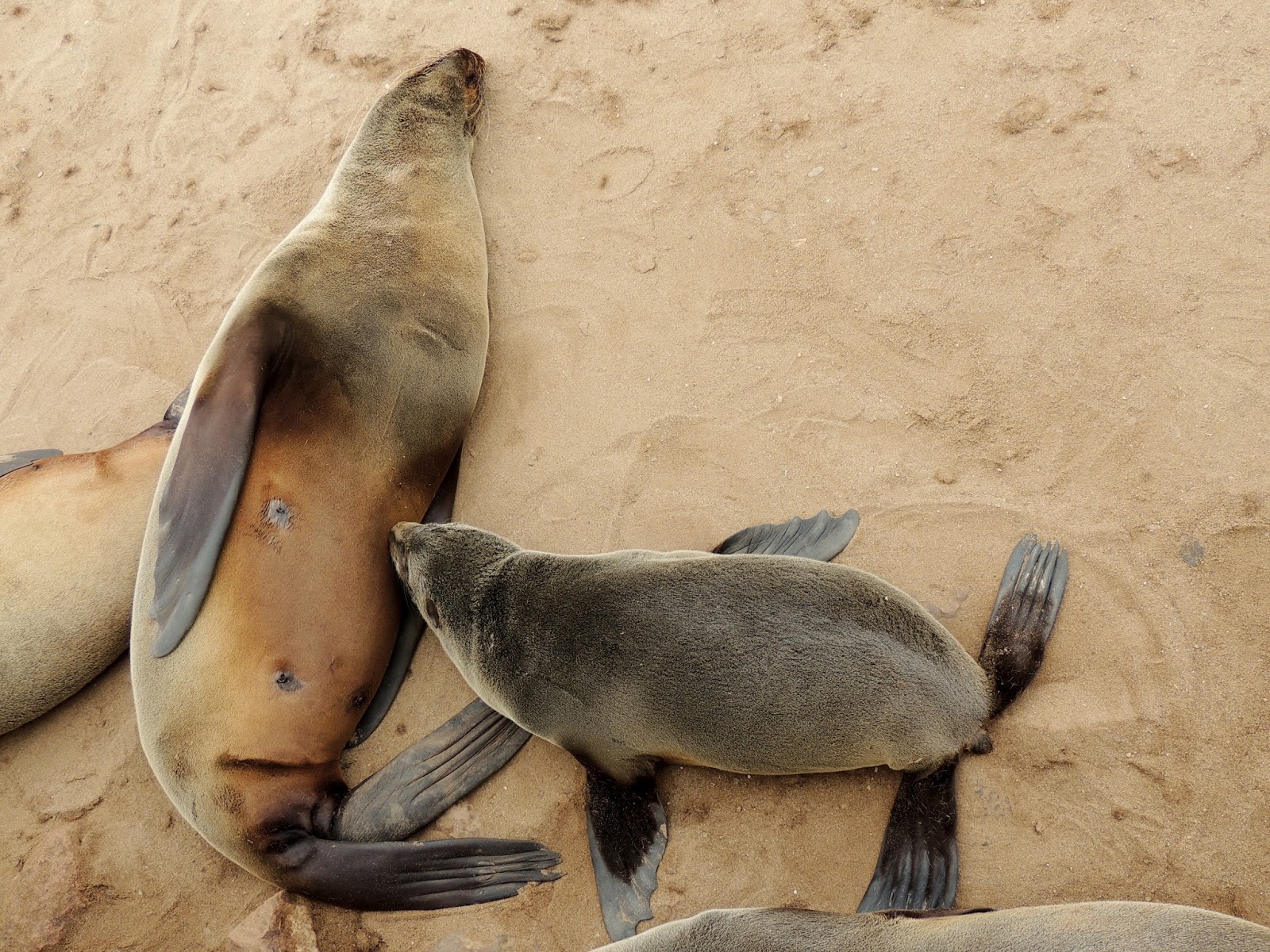

The majority of living eared seals belong to the Otariidae, which have been divided in the past between the fur seals and sea lions. Fur seals tend to be smaller than sea lions and possess a dense layer of underfur. However, more recent phylogenetic studies (particularly molecular ones) have thrown this distinction out the window (e.g. Higdon et al. 2007). Instead, the northern fur seal Callorhinus ursinus of the north Pacific is probably the sister species to all other living otariids. Even the southern fur seals, generally placed in a single genus Arctocephalus, may not be monophyletic relative to the New Zealand sea lion Phocarctos hookeri (as a result, some authors have suggested resurrecting the genus Arctophoca for all southern fur seals other than the South African fur seal Arctocephalus pusillus). The South American fur seal Otaria flavescens may also be associated with this latter group. The two north Pacific sea lions, Steller’s sea lion Eumetopias jubatus and the Californian sea lion Zalophus californianus, form a clade outside the southern otariids. The remaining species is the Australian sea lion Neophoca cinerea whose position has been harder to pin down: some analyses place it close to the New Zealand sea lion but others position it well away from all other southern otariids, possibly even outside all other otariids except the northern fur seal.

Fur seals and sea lions were heavily hunted in the past for pelts and oil and some species remain endangered. Climate change poses a particular threat to cold-water species; for instance, recent years have seen significant contractions in walrus ranges, leading to dramatic crowding in the locations remaining. Conversely, the Antarctic fur seal Arctocephalus gazella, once feared extinct, has apparently exhibited a population explosion in recent decades, perhaps because lowered whale populations have led to more food being available for seals.
Systematics of Otarioidea
<==Otarioidea [Desmatophocidae]AG06
    |  i. s.: Atopotarus Downs 1956BDR85
    |         Prototaria Takeyama & Ozawa 1984BDR85
    |           `--P. primigena Takeyama & Ozawa 1984BDR85
    |         Oriensarctos Mitchell 1968BDR85
    |--OdobenidaeSM93
    |    |  i. s.: Pliopedia Kellogg 1921BDR85
    |    |         Ontocetus Leidy 1859BDR85
    |    |           `--O. oxymycterus Kellogg 1925B76
    |    |         Trichecodon Lankester 1865BDR85
    |    |         Valenictus Mitchell 1961BDR85
    |    |         Proneotherium repenningiMJ11
    |    |--+--Pinnarctidion Barnes 1979BDR85
    |    |  `--Allodesmus Kellogg 1922 [Allodesminae]BDR85
    |    |       |--A. courseni (Downs 1956)B76
    |    |       |--A. kernensis Kellogg 1922BDR85
    |    |       `--A. packardiBDR85
    |    `--+--Neotherium Kellogg 1931BDR85
    |       |--+--Imagotaria Mitchell 1968 [Imagotariinae]BDR85
    |       |  |    `--I. downsi Mitchell 1968Re76
    |       |  `--Pontoleon True 1905 [=Pontolis True 1906]BDR85
    |       |       `--‘Pontolis’ magnus (True 1905)Ra76
    |       `--+--Dusignathus Kellogg 1927 [Dusignathinae]BDR85
    |          `--+--+--Prorosmarus Berry & Gregory 1906BDR85
    |             |  `--Alachtherium du Bus 1867BDR85
    |             `--+--Aivukus Repenning & Tedford 1977BDR85
    |                |    `--A. cedrosensis Repenning & Tedford 1977BDR85
    |                `--Odobenus [incl. Hemicaulodon Cope 1869; Odobeninae]BDR85
    |                     `--O. rosmarusMJ11
    |                          |--O. r. rosmarusMSG86
    |                          `--O. r. divergensMSG86
    `--+--Desmatophoca Condon 1906 [Desmatophocinae]BDR85
       |    |--D. brachycephalaMJ11
       |    `--D. oregonensis Condon 1906Ra76
       `--+--EnaliarctidaeBDR85
          |    |--Kamtschatarctos Dubrovo 1981 [Kamtschatarctinae]BDR85
          |    |    `--K. sinelnikovae Dubrovo 1981BDR85
          |    `--EnaliarctinaeBDR85
          |         |--Kolponomos clallamensis Stirton 1960BDR85
          |         `--Enaliarctos Mitchell & Tedford 1973BDR85
          |              |--E. mealsi Mitchell & Tedford 1973Re76
          |              `--E. mitchelliD07
          `--OtariidaeBDR85
               |  i. s.: Pteronarctos Barnes 1989SM93
               |--Pithanotaria Kellogg 1925BDR85
               |    `--P. starri Kellogg 1925Re76
               `--+--CallorhinaeAG06
                  |    |--Callorhinus ursinusAG06
                  |    `--Thalassoleon Repenning & Tedford 1977BDR85
                  `--Otariinae [Arctocephalinae]AG06
                       |--+--‘Arctocephalus’ gazellaFS15
                       |  `--+--+--+--‘Arctocephalus’ philippiiFS15
                       |     |  |  `--‘Arctocephalus’ townsendiFS15
                       |     |  `--+--‘Arctocephalus’ forsteri (Lesson 1828)FS15, W09 [=Otaria forsteriW09]
                       |     |     `--+--‘Arctocephalus’ australis (Zimmermann 1782)AG06, C57 (see below for synonymy)
                       |     |        `--‘Arctocephalus’ galapagoensis Heller 1904FS15, C57
                       |     `--+--Phocarctos hookeri (Gray 1844)FS15, H01
                       |        `--NeophocaAG06
                       |             |--N. cinereaAG06
                       |             |--N. hookeriBP87
                       |             `--N. palatina King 1983BDR85
                       `--+--+--EumetopiasFS15
                          |  |    |--E. jubatus Schreber 1776AG06, M76
                          |  |    `--E. ojiyaensis Horikawa 1981BDR85
                          |  `--Zalophus Gill 1866FS15, C57
                          |       |--Z. japonicus (Peters 1866)FS15, I92 [=Z. californianus japonicusI92]
                          |       `--+--Z. californianusFS15 (see below for synonymy)
                          |          `--Z. wollebaeki Sivertsen 1953FS15, C57 [=Z. californianus wollenbaekiBP87]
                          `--+--Otaria Péron 1816FS15, C57 (see below for synonymy)
                             |    |--O. flavescens (Shaw 1800) (see below for synonymy)C57
                             |    |--O. byronia (Blainville 1820)AG06, C57 (see below for synonymy)
                             |    |--O. cinereaW09
                             |    |--O. hookeriS66
                             |    `--O. jubataT99
                             `--Arctocephalus Geoffroy & Cuvier 1826FS15, C57 (see below for synonymy)
                                  |  i. s.: A. cinereusH79
                                  |         A. hookeri Gray 1866W09
                                  |         A. lobatusH79
                                  |         ‘Gypsophoca’ subtropicalisH79
                                  |         A. tropicalisIT07
                                  |--A. (Arctocephalus) pusillusAG06 [=Phoca pusillaC57; incl. *A. ursinusC57]
                                  |    |--A. p. pusillusH16
                                  |    `--A. p. doriferusH16
                                  `--A. (Hydrarctos de Muizon 1978)BDR85
Inorganic: Callorhinus ursinus minilorientalus Okamura 1987O87
           Eumetopias jubata protominilorientalis Okamura 1987O87
           Zalophus californianus minilorientalus Okamura 1987O87
           Zalophus californianus protominilorientalus Okamura 1987O87
Arctocephalus Geoffroy & Cuvier 1826AG06, C57 [incl. Euotaria Gray 1866C57, Gypsophoca Gray 1866C57, Halarctus Gill 1866C57]
Arctocephalus australis (Zimmermann 1782)AG06, C57 [=Phoca australisC57, Otaria australisC57; incl. Otaria (Arctophoca) argentata Philippi in Peters 1871C57, O. brachydactyla Philippi 1892C57, Phoca falklandica Shaw 1800C57, Arctocephalus falklandicusC57, Otaria falklandicaC57, Phoca falclandicaC57, Arctocephalus (Arctophoca) gracilis Nehring 1887C57, A. grayii Scott 1873C57, O. hauvilli Lesson 1827C57, A. latirostris Gray 1872C57, Euotaria latirostrisC57, Otaria leucostoma Philippi 1892C57, Phoca lupina Molina 1782C57, Arctocephalus nigrescens Gray 1850C57, Euotaria nigrescensC57, Otaria (Arctophoca) nigrescensC57, O. (A.) philippii Peters 1866C57, Arctocephalus philippiiC57, Phoca porcina Molina 1782C57, Otaria porcinaC57, O. shawii Lesson 1828C57]
Otaria Péron 1816AG06, C57 [incl. Otiphoca Blainville 1840C57, Otoes Fischer 1817C57, Platyrhincus Cuvier 1827C57]
Otaria byronia (Blainville 1820)AG06, C57 [=Phoca byroniaC57, Macrorhinus byroniiC57, Mirounga byroniiC57]
Otaria flavescens (Shaw 1800) [=Phoca flavescens; incl. Ph. aurita Bechstein 1800, Otaria chilensis Müller 1841, O. chonotica Philippi 1892, O. fulva Philippi 1892, O. godeffroyi Peters 1866, Phoca leonina Molina 1782 non Linnaeus 1758, *O. leonina, Platyrhincus leoninus, O. minor Gray 1874, O. molossina Lesson & Garnot 1826, Pl. molossinus, O. pernettyi Lesson 1828, O. pygmaea Gray 1874, O. rufa Philippi 1892, O. ulloae Tschudi 1844, Platyrhincus uraniae Lesson 1827, O. velutina Philippi 1892]C57
Zalophus californianusFS15 [=Otaria californianaC57; incl. O. gillespiiC57, *Zalophus gillespiiC57]
*Type species of generic name indicated
References
[AG06] Arnason, U., A. Gullberg, A. Janke, M. Kullberg, N. Lehman, E. A. Petrov & R. Väinölä. 2006. Pinniped phylogeny and a new hypothesis for their origin and dispersal. Molecular Phylogenetics and Evolution 41 (2): 345–354.
[B76] Barnes, L. G. 1976. Outline of eastern North Pacific fossil cetacean assemblages. Systematic Zoology 25 (4): 321–343.
[BDR85] Barnes, L. G., D. P. Domning & C. E. Ray. 1985. Status of studies on fossil marine mammals. Marine Mammal Science 1 (1): 15–53.
Boessenecker, R. W., & M. Churchill. 2013. A reevaluation of the morphology, paleoecology, and phylogenetic relationships of the enigmatic walrus Pelagiarctos. PLoS One 8 (1): e54311.
[BP87] Burton, J. A., & B. Pearson. 1987. Collins Guide to the Rare Mammals of the World. Collins: London.
[C57] Cabrera, A. 1957. Catalogo de los mamiferos de America del Sur. I (Metatheria—Unguiculata—Carnivora). Revista del Museo Argentino de Ciencias Naturales “Bernardino Rivadavia” e Instituto Nacional de Investigacion de Las Ciencias Naturales, Ciencias Zoológicas 4 (1): 1–307.
[D07] Dixon, D. 2007. The Complete Illustrated Encyclopedia of Dinosaurs & Prehistoric Creatures. Hermes House: London.
[FS15] Faurby, S., & J.-C. Svenning. 2015. A species-level phylogeny of all extant and late Quaternary extinct mammals using a novel heuristic-hierarchical Bayesian approach. Molecular Phylogenetics and Evolution 84: 14–26.
[H01] Harcourt, R. G. 2001. Advances in New Zealand mammalogy 1990-2000: pinnipeds. Journal of the Royal Society of New Zealand 31 (1): 135–160.
[H79] Haast, J. von. 1879. Geology of the Provinces of Canterbury and Westland, New Zealand. A report comprising the results of official explorations. “Times” Office: Christchurch.
[H16] Hall, L. S. 2016. Field Guide to Australian Mammals. Pascal Press: Glebe (Australia).
Higdon, J. W., O. R. P. Bininda-Emonds, R. M. D. Beck & S. H. Ferguson. 2007. Phylogeny and divergence of the pinnipeds (Carnivora: Mammalia) assessed using a multigene dataset. BMC Evolutionary Biology 7: 216.
[IT07] Isaac, N. J. B., S. T. Turvey, B. Collen, C. Waterman & J. E. M. Baillie. 2007. Mammals on the EDGE: conservation priorities based on threat and phylogeny. PloS One 2 (3): e296.
[I92] Iwahashi, J. (ed.) 1992. Reddo Deeta Animaruzu: a pictorial of Japanese fauna facing extinction. JICC: Tokyo.
[M76] Masui, M. 1976. Nihon no Doobutsu. Kogakukan: Tokyo.
[MSG86] McLaren, S. B., D. A. Schlitter & H. H. Genoways. 1986. Catalog of the Recent marine mammals in the Carnegie Museum of Natural History. Annals of Carnegie Museum 55 (11): 237–296.
[MJ11] Meredith, R. W., J. E. Janečka, J. Gatesy, O. A. Ryder, C. A. Fisher, E. C. Teeling, A. Goodbla, E. Eizirik, T. L. L. Simão, T. Stadler, D. L. Rabosky, R. L. Honeycutt, J. J. Flynn, C. M. Ingram, C. Steiner, T. L. Williams, T. J. Robinson, A. Burk-Herrick, M. Westerman, N. A. Ayoub, M. S. Springer & W. J. Murphy. 2011. Impacts of the Cretaceous terrestrial revolution and KPg extinction on mammal diversification. Science 334: 521–524.
[O87] Okamura, C. 1987. New facts: Homo and all Vertebrata were born simultaneously in the former Paleozoic in Japan. Original Report of the Okamura Fossil Laboratory 15: 347–573.
[Ra76] Ray, C. E. 1976. Fossil marine mammals of Oregon. Systematic Zoology 25 (4): 420–436.
[Re76] Repenning, C. A. 1976. Adaptive evolution of sea lions and walruses. Systematic Zoology 25 (4): 375–390.
Repenning, C. A., & R. H. Tedford. 1977. Otarioid seals of the Neogene. Geological Society Professional Paper 992: i–vi, 1–93, 24 pls.
[S66] Sclater, P. L. 1866. Notice of some recent additions to the Society’s menagerie. Proceedings of the Zoological Society of London 1866: 80.
[SM93] Stucky, R. K., & M. C. McKenna. 1993. Mammalia. In: Benton, M. J. (ed.) The Fossil Record 2 pp. 739–771. Chapman & Hall: London.
[T99] Tandler, J. 1899. Zur vergleichenden Anatomie der Kopfarterien bei den Mammalia. Denkschriften der Kaiserlichen Akademie der Wissenschaften, Mathematische-Naturwissenschaftliche Klasse, Wien 67: 677–784, pls 1–8.
[W09] Waite, E. R. 1909. Vertebrata of the Subantarctic islands of New Zealand. In: Subantarctic Islands of New Zealand pp. 541–551. John Mackay, Government Printer: Wellington (New Zealand).