
Belongs within: Corvides.
Contains: Pachycephala.
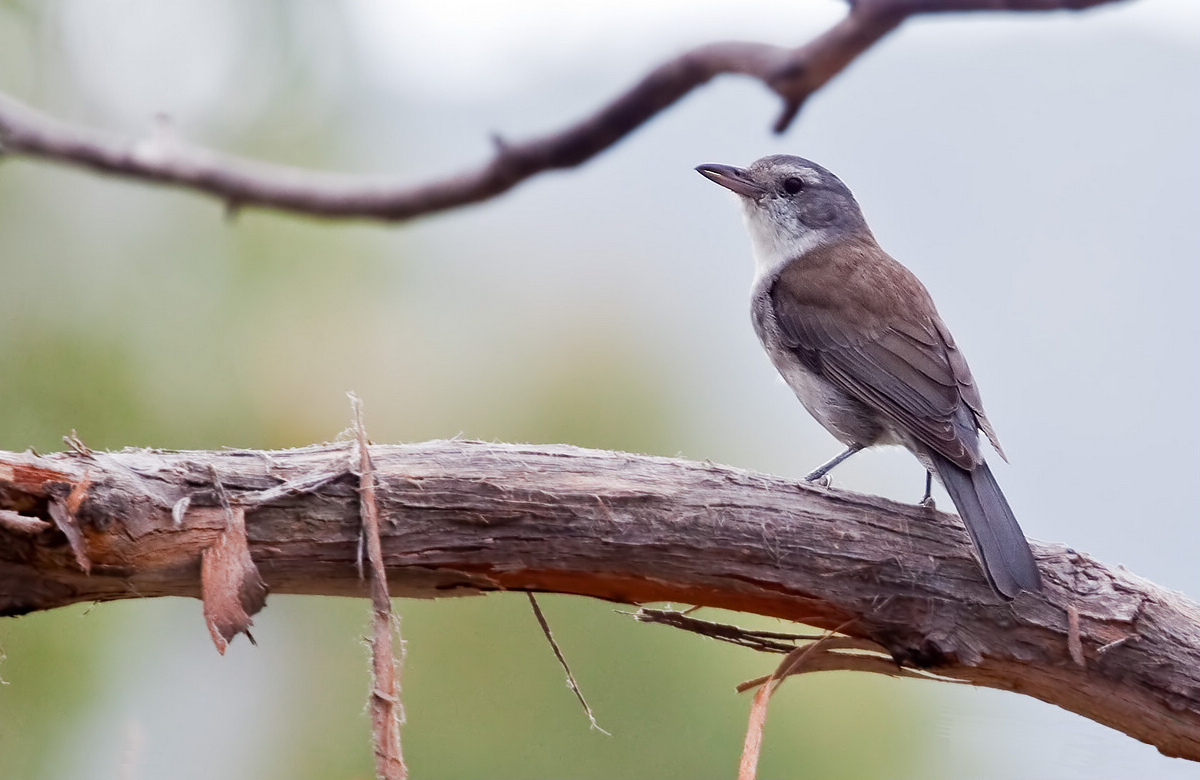
The Pachycephalidae, whistlers and shrike-thrushes, are stout-bodied insectivorous birds found in Australasia and southeast Asia. In its current circumscription, the group is primarily supported by molecular data. The shrikethrushes of the genus Colluricincla are relatively slender-bodied members of the family with generally grey or brown plumage. The crested shrike-tit Falcunculus frontalis has a relatively massive bill and black and white stripes on the head.
Whistling for whistlers
Published 7 January 2013

The name Pachycephalidae (or some orthographic variant thereof such as Pachycephalinae) has long been used to refer to a group of small insectivorous birds from the Australo-Papuan region (summarised by Boles 1979 as ‘large-headed stout-bodied birds with poorly developed rictal bristles’). In the past, taxa included in the Pachycephalidae included the New Zealand genera Mohoua and Turnagra, the crested shriketit Falcunculus frontatus and the crested bellbird Oreoica gutturalis. However, as has often been the case with the more generalised groups of passerine birds, recent authors have tended to whittle the family’s contents down as molecular studies have scattered the constituent taxa about the family tree. In its most recent iterations, Pachycephalidae generally corresponds to the taxa included in clade ‘CC5CC6b’ of Jetz et al. (2012), comprising primarily the genera Pachycephala and Colluricincla, plus a small number of satellite taxa.

The genus Pachycephala is currently used for the whistlers, a group of about forty species of mostly long-tailed, stout-billed birds, often (but not always) with sexually dimorphic coloration, with a contrasting pectoral band (most often black in the males) dividing the throat from the chest. The exact number of species in the genus is somewhat uncertain due to disagreements about the status of several constituent populations: the golden whistler P. pectoralis complex, for instance, includes over 65 named taxa variously recognised as species or subspecies (Jønsson et al. 2010). Species of Pachycephala are found from southeast Asia through to Fiji and Tonga. Some of you may recall whistlers featuring in Dougal Dixon’s Life after Man as giving rise to an island radiation including nut-cracking, wood-pecking and predatory species (my only question being, who was the Hart that the plesiomorphic species in the radiation is supposed to be named after?)

Colluricincla, the shrike-thrushes, includes at least four species found in Australia and New Guinea (excluding a couple of species better included in Pachycephala). They are larger, slenderer and more narrow-headed than the whistlers, with less dimorphic coloration. The grey shrike-thrush C. harmonica of Australia has a high reputation as a singer. Some recent authors have also suggested inclusion of two further New Guinean species, the rusty pitohui Pitohui ferrugineus and white-bellied pitohui P. incertus, in Colluricincla. The genus Pitohui has been used to include a group of about half a dozen New Guinean species in the Pachycephalidae, which are relatively large and brash as pachycephalids go. They are variously reddish, black, or some combination of the two (the white-bellied pitohui has, as its name indicates, a yellowish-white underside). They have become most notorious in recent years for the discovery that, with the apparent exception of P. incertus, they are in fact toxic, with their skin and feathers containing batrachotoxins comparable to those found in the arrow-poison frogs of South America. Like the arrow-poison frogs, the birds probably do not generate the toxin themselves, but accumulate it from a diet of toxin-carrying melyrid beetles. However, molecular studies have indicated that the genus Pitohui as previously recognised is polyphyletic. The hooded pitohui P. dichrous and the variable pitohui P. kirhocephalus, the latter of which is the type species of the genus, are more closely related to the Oriolidae than the Pachycephalidae, while three species remain close to Pachycephala and Colluricincla. As well as the two species mentioned previously (which may be included in Colluricincla or maintained as a distinct genus for which the name Pseudorectes is available), the black pitohui ‘Pitohui’ nigrescens should be included in the Pachycephalidae as its own genus Melanorectes. As well as being closer to black than the reddish Pseudorectes species, Melanorectes nigrescens apparently possesses a ‘peculiar musky smell’ (Rothschild & Hartert 1913).

The remaining two species of the Pachycephalidae are placed by Jønsson et al. (2010) in the genus Coracornis: the maroon-backed whistler C. raveni of Sulawesi and the Sangihe shrike-thrush C. sanghirensis of Sangihe, north of Sulawesi (as the vernacular name suggests, this species was previously included in Colluricincla). Neither of these species appears to be particularly well-known: in particular, C. sanghirensis was first described in 1881 but not observed again for over 100 years until 1985 (Rozendaal & Lambert 1999). So long was the gap between observations that several authors had, in this time, assumed that the original specimen must have been mislabelled and come from somewhere in New Guinea rather than Sangihe. This misinterpretation was encouraged by the belief that the species was directly related to the little shrike-thrush Colluricincla megarhyncha, found on the wrong side of the Wallace line to easily colonise Sangihe. As it is, C. sanghirensis is restricted to only a small area of forest on Sangihe at an altitude above 600 m, and was regarded by Rozendaal & Lambert (1999) as critically endangered. Its identification with Coracornis rather than Colluricincla was done by Jønsson et al. (2010) on the basis of molecular analysis; when comparing C. sanghirensis with Colluricincla, Rozendaal & Lambert (1999) do not appear to have also considered Coracornis raveni.
Systematics of Pachycephalidae
<==Pachycephalidae
    |  i. s.: Falcunculus Vieillot 1816AP21, B94 [Falcunculidae]
    |           `--F. frontatus (Latham 1801) [=Lanius frontatus]WS48
    |                |--F. f. frontatusWS48
    |                |--F. f. leucogaster Gould 1848 [incl. F. leucogaster stirlingi Mathews 1915]WS48
    |                `--F. f. whitei Campbell 1910WS48
    |         PseudorectesAP21
    |           |--P. ferrugineusAP21
    |           `--P. incertusAP21
    |--+--Melanorectes nigrescensJF11 [=Pitohui nigrescensBKB15]
    |  `--+--PachycephalaBKB15
    |     `--CoracornisBKB15
    |          |--C. raveniBKB15 [=Colluricincla raveniJF11]
    |          `--C. sanghirensisAP21 [=Colluricincla’ sanghirensisJF11]
    `--+--+--‘Pitohui’ ferrugineusBKB15
       |  `--‘Pitohui’ incertusBKB15
       `--ColluricinclaBKB15
            |  i. s.: C. brunnea Gould 1840WS48 (see below for synonymy)
            |         C. ferrugineusJF11
            |         C. parvula Gould 1845WS48 [=C. megarhyncha parvulaM03; incl. C. parvula conigravi Mathews 1912WS48]
            |         C. rufiventris Gould 1840WS48 (see below for synonymy)
            |         C. tenebrosaAP21
            |--C. megarhynchaBKB15
            |    |--C. m. megarhynchaM03
            |    `--C. m. rufogasterM03
            `--+--C. woodwardi Hartert 1905BKB15, WS48 [incl. C. woodwardi assimilis Mathews 1914WS48]
               |    |--C. w. woodwardiM03
               |    `--C. w. didimusM03
               `--+--C. boweriBKB15
                  `--C. harmonica (Latham 1801)BKB15, PB96
                       |--C. h. harmonicaM03
                       |--C. h. halmaturinaM03
                       |--C. h. kolichisiM03
                       |--C. h. pallescensM03
                       |--C. h. strigataM03
                       |--C. h. superciliosaM03
                       `--C. h. whiteiM03
Colluricincla brunnea Gould 1840WS48 [=C. harmonica brunneaM03; incl. C. brunnea julietae Mathews 1942WS48, C. brunnea parryi Mathews 1912WS48, C. brunnea roebucki Mathews 1912WS48]
Colluricincla rufiventris Gould 1840WS48 [=C. harmonica rufiventrisM03; incl. C. rufiventris carteri Mathews 1923WS48, C. rufiventris murchisoni Mathews 1912WS48, C. harmonica murchisoniiM03]
*Type species of generic name indicated
References
[AP21] Arlott, N., & B. van Perlo. 2021. Collins Birds of the World. William Collins.
[B94] Bock, W. J. 1994. History and nomenclature of avian family-group names. Bulletin of the American Museum of Natural History 222: 1–281.
Boles, W, E. 1979. The relationships of the Australo-Papuan flycatchers. Emu 79: 107–110.
[BKB15] Burleigh, J. G., R. T. Kimball & E. L. Braun. 2015. Building the avian tree of life using a large-scale, sparse supermatrix. Molecular Phylogenetics and Evolution 84: 53–63.
Jønsson, K. A., R. C. K. Bowie, R. G. Moyle, L. Christidis, J. A. Norman, B. W. Benz & J. Fjeldså. 2010. Historical biogeography of an Indo-Pacific passerine bird family (Pachycephalidae): different colonization patterns in the Indonesian and Melanesian archipelagos. Journal of Biogeography 37: 245–257.
[JF11] Jønsson, K. A., P.-H. Fabre, R. E. Ricklefs & J. Fjeldså. 2011. Major global radiation of corvoid birds originated in the proto-Papuan archipelago. Proceedings of the National Academy of Sciences of the USA 108 (6): 2328–2333.
[M03] Morcombe, M. 2003. Field Guide to Australian Birds 2nd ed. Steve Parish Publishing.
[PB96] Palma, R. L., & S. C. Barker. 1996. Phthiraptera. In: Wells, A. (ed.) Zoological Catalogue of Australia vol. 26. Psocoptera, Phthiraptera, Thysanoptera pp. 81–247. CSIRO Publishing: Melbourne.
Rothschild, W., & E. Hartert. 1913. List of the collections of birds made by Albert S. Meek in the lower ranges of the Snow Mountains, on the Eilanden River, and on Mount Goliath during the years 1910 and 1911. Novitates Zoologicae 20 (3): 473–527.
Rozendaal, F. G., & F. R. Lambert. 1999. The taxonomic and conservation status of Pinarolestes sanghirensis Oustalet 1881. Forktail 15: 1–13.
[WS48] Whittell, H. M., & D. L. Serventy. 1948. A systematic list of the birds of Western Australia. Public Library, Museum and Art Gallery of Western Australia, Special Publication 1: 1–126.