
Belongs within: Agaricomycetes.
Contains: Meruliaceae, Phanerochaetaceae, Irpicaceae, Steccherinaceae, Cerrenaceae, Hyphodermataceae, Meripilaceae, Podoscyphaceae, Incrustoporiaceae, Cyphellaceae, Dacryobolaceae, Fomitopsidaceae, Laetiporaceae, Polyporaceae.
The Polyporales are a diverse clade of fungi supported by molecular data, commonly associated with rotting wood, some species of which cause economic damage to timber and/or living hardwoods. Many familiar members of this clade produce perennial, bracket-shaped fruiting bodies but others produce more ephemeral fruiting bodies or grow as crust-like forms without discrete fruiting bodies. Major subdivisions within the Polyporales may be identified by molecular data but are difficult to define morphologically.
The colours of rot
Published 24 January 2018


Apart from those species readily purchased at the supermarket, perhaps the macrofungi most likely to be encountered by the average person are the brackets. Bracket fungi are the hard, woody, shelf-like fungi that may be found growing from tree-stumps and fallen logs. Whereas other fungal fruiting bodies may emerge, release their spores, and collapse away within a matter of hours, those produced by bracket fungi (properly known as ‘conks’, apparently) may persist for years with a new layer of reproductive tissue added each cycle.


The majority of brackets belong to the fungal order Polyporales, one of the major subgroups of the basidiomycetes with about 1800 known species (Binder et al. 2013). While brackets may be the most familiar Polyporales, the order is morphologically diverse. Indeed, no one morphological feature characterises the Polyporales as currently recognised; it has only been recognised as a clade following the advent of molecular analyses. Some members of the Polyporales produce persistent fruiting bodies like brackets, others are more ephemeral. They may be sessile and shelf-like, or they may be raised on a stalk. The spore-producing layer may appear as minute pores, as gills, as protruding teeth, or may be entirely smooth. There are also a large number of Polyporales species that are what is known as resupinate: that is, they don’t produce discrete fruiting bodies at all. Instead, the reproductive structures are produced as a more or less undifferentiated crust spreading over their substrate.


The greater number of Polyporales are associated with decaying wood; they play an integral role in breaking down and releasing nutrients that might otherwise be locked away from environmental cycles. Most species only grow on wood that is already deceased but there are some that are pathogenic on living trees. Based on the appearance of the wood being broken down, Polyporales may be divided between ‘white-rot’ and ‘brown-rot’ species. The difference is not merely an aesthetic one. Wood is made up primarily of two organic polymers, cellulose and lignin. Both these chemicals are difficult to metabolise (we ourselves, for instance, cannot digest either) but lignin is a particularly tough nut to crack. White-rot fungi are able to digest both cellulose and lignin but brown-rot fungi digest the cellulose only. White-rot fungi extract more nutrients from the wood overall but brown-rot fungi extract nutrients faster. And while the efforts of white-rot fungi may result in almost the entire carbon quotient of the wood being released to the environment, brown-rot fungi leave a lignin-rich residue that is largely indigestable by any other organism. Genomes have been sequenced from both white- and brown-rot taxa and a fair amount of effort has been invested into studying the different chemical pathways underlying the different rot types.


Phylogenetically speaking, Justo et al. (2017) recently recognised eighteen families within Polyporales corresponding to well-established molecular clades (plus a handful of taxa that could not yet be confidently placed in a ‘family’) but these show the same challenges to morphological characterisation as the order as a whole. Many of these families include both fruiting and resupinate taxa, and transitions in fruiting body morphology are the rule more than the exception. Interestingly, one ‘morphological’ feature that does show a fair degree of phylogenetic consistency is the rot-type. It seems clear that the ancestor of the Polyporales was a white-rot fungus with the majority of brown-rot fungi forming a single clade within the order. Only one known brown-rot fungus genus , Lentiporus, definitely evolved separately from the rest (another genus, Auriporia, may or may not represent a further origin of brown rot). One question that remains to be answered is whether the chemical basis of brown rot in Laetiporus is the same as that in the main brown-rot clade.
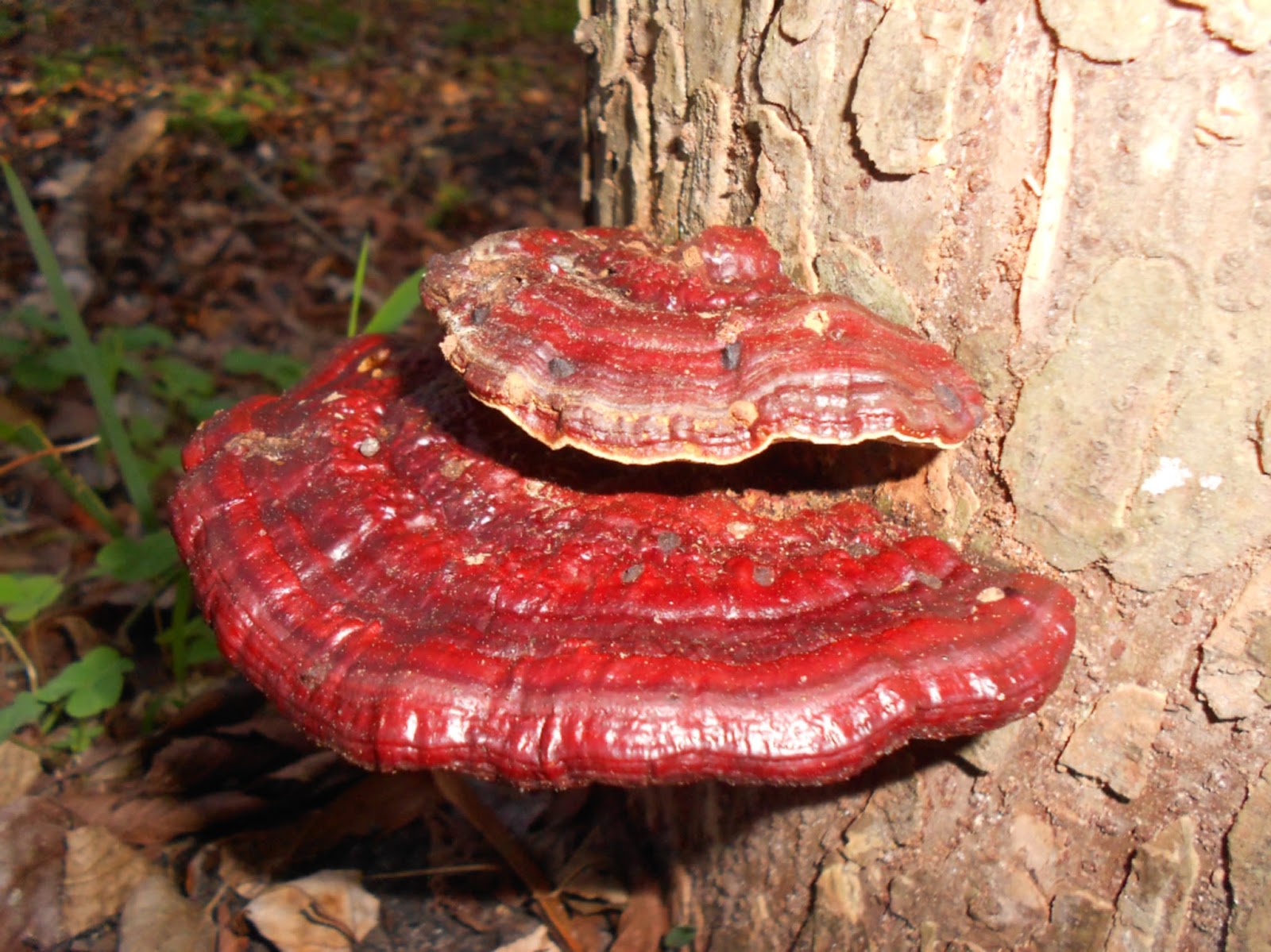

Apart from their role in breaking down wood, not too many Polyporales have a direct economic significance. Some, notably the lingzhi Ganoderma lucidum, are grown commercially for use in Chinese medicine. Some species with more fleshy fruiting bodies are edible: notable examples include the cauliflower fungi Sparassis species and the chicken of the woods Laetiporus sulphureus (guess what it’s supposed to taste like). According to its Wikipedia page, chicken of the woods may cause a toxic reaction to some diners but there seems to be some question about whether this is due to toxins produced by the fungus itself or whether the fungus is absorbing toxins contained in the wood it is growing from. For other polypores, the question of toxicity may be rendered moot by the fact that any attempt to eat one would break one’s teeth.
Systematics of Polyporales
<==Polyporales [Lentinaceae, Poriales]
    |--+--+--Candelabrochaete Boidin 1970JM17, KC01
    |  |  |    `--C. africanaBH05
    |  |  `--phlebioid cladeJM17
    |  |       |--MeruliaceaeJM17
    |  |       `--+--PhanerochaetaceaeJM17
    |  |          `--IrpicaceaeJM17
    |  `--residual cladeJM17
    |       |--+--+--‘Junghuhnia’ nitidaBH05
    |       |  |  `--‘Antrodiella’ semisupinaBH05
    |       |  `--+--SteccherinaceaeJM17
    |       |     `--+--PanaceaeJM17
    |       |        |    |--Panus Fr. 1838 (nom. cons.) (see below for synonymy)KC01
    |       |        |    |    |--P. fragilisJM17
    |       |        |    |    `--P. rudisBH05
    |       |        |    `--Cymatoderma Jungh. 1840JM17, KC01 (see below for synonymy)
    |       |        |         |--*C. elegansJM17
    |       |        |         |--C. caperatumBH05
    |       |        |         `--‘Cladoderris’ crassaSS16
    |       |        `--CerrenaceaeJM17
    |       `--+--+--+--Bulbillomyces Jülich 1974JM17, KC01 (see below for synonymy)
    |          |  |  |    `--B. farinosus [anam. Aegerita candida]BH05
    |          |  |  `--Hypochnicium Erikss. 1958JM17, KC01 [incl. Nodotia Hjortstam 1987KC01]
    |          |  |       |--*H. bombycinumJM17
    |          |  |       |--H. cystidiatumBH05
    |          |  |       |--H. eichleriBH05
    |          |  |       |--H. geogeniumBH05
    |          |  |       |--H. karsteniiJM17
    |          |  |       `--H. polonenseBH05
    |          |  `--+--Climacocystis Kotl. & Pouzar 1958JM17, KC01
    |          |     |    `--C. borealisJM17
    |          |     |--‘Diplomitoporus’ crustulinusBH05
    |          |     |--‘Phlebia’ bresadolaeJM17
    |          |     `--RickioporaJM17
    |          `--+--+--HyphodermataceaeBH05
    |             |  `--MeripilaceaeJM17
    |             `--PodoscyphaceaeJM17
    `--+--Ischnoderma Karst. 1879KC01 [IschnodermataceaeJM17]
       |    |--I. benzoinumBH05
       |    `--I. resinosumARH07
       `--+--+--+--‘Tyromyces’ merulinusJM17
          |  |  `--IncrustoporiaceaeJM17
          |  `--Antrodia cladeJM17
          |       |  i. s.: CyphellaceaeKC01
          |       |         Ryvardenia Rajchenb. 1994JM17, KC01
          |       |         GilbertsoniaJM17
          |       |         PiptoporellusJM17
          |       |--+--+--Sarcoporia Karst. 1894JM17, KC01
          |       |  |  |    `--*S. polysporaJM17
          |       |  |  `--+--SparassidaceaeJM17
          |       |  |     |    |--Sparassiella Schwarzman 1964KC01
          |       |  |     |    `--Sparassis Fr. 1819 [=Masseeola Kuntze 1891]KC01
          |       |  |     |         |--S. brevipesBH05
          |       |  |     |         |--S. crispaLK04
          |       |  |     |         |--S. latifoliaJM17
          |       |  |     |         |--S. radicataJM17
          |       |  |     |         |--S. ramosaKC01
          |       |  |     |         `--S. spathulataBH05
          |       |  |     `--Crustoderma Parmasto 1968JM17, KC01
          |       |  |          |--C. corneumJM17
          |       |  |          `--+--C. flavescensJM17
          |       |  |             `--Pycnoporellus Murrill 1905JM17, KC01 [incl. Aurantiporellus Murrill 1905KC01]
          |       |  |                  |--*P. fulgensJM17
          |       |  |                  `--P. alboluteusB14
          |       |  `--DacryobolaceaeJM17
          |       `--+--+--Fibroporia Parmasto 1968JM17, KC01
          |          |  |    |--+--*F. vaillantiiJM17
          |          |  |    |  `--F. radiculosaJM17
          |          |  |    `--+--F. gossypiumJM17
          |          |  |       `--F. pseudorennyiJM17
          |          |  `--Amyloporia Singer 1944JM17, KC01
          |          |       |--+--A. sinuosaJM17
          |          |       |  `--*Rhodonia placenta [=Postia placenta]JM17
          |          |       `--+--A. stratosaJM17
          |          |          `--+--*A. xanthaJM17
          |          |             `--A. carbonicaJM17
          |          `--+--FomitopsidaceaeJM17
          |             `--LaetiporaceaeJM17
          `--+--+--Auriporia Ryvarden 1973JM17, KC01
             |  |    `--A. aureaBH05
             |  `--+--Mycoleptodonoides Nikol. 1952JM17, KC01
             |     |    `--M. vassiljevaeJM17
             |     `--GelatoporiaceaeJM17
             |          |--Gelatoporia Niemelä 1985KC01
             |          |    |--G. pannocinctaBH05
             |          |    `--G. subvermispora [=Ceriporiopsis subvermispora]JM17
             |          |--Obba rivulosaJM17
             |          |--Cinereomyces Jülich 1982JM17, KC01
             |          `--SebiporaJM17
             `--+--Grifola Gray 1821KC01 (see below for synonymy)
                |    |--G. frondosaJK06
                |    `--G. sordulentaJK06
                `--PolyporaceaeJM17

Polyporales incertae sedis:
  Phellinites Singer & Archang. 1958T93. KC01
    `--P. digiustoi Singer & Archangelsky 1958T93
  Amyloporiella David & Tortič 1984KC01
  Anomoporia Pouzar 1966KC01
    |--A. albolutescensBH05
    |--A. bombycinaBH05
    `--A. kamtschaticaBH05
  Australoporus Buchanan & Ryvarden 1988KC01
  Austrolentinus Ryvarden 1991KC01
  BoreostereaceaeKC01
    |--Chaetodermella Rauschert 1988KC01
    |--Mycobonia Pat. 1894 (nom. cons.) (see below for synonymy)KC01
    |--Mycothele Jülich 1976KC01
    |--Boreostereum Parmasto 1968KC01
    |    `--B. radiatumBH05
    `--Columnocystis Pouzar 1959KC01
         |--C. abietinaBH05
         `--C. ambiguaBH05
  Bridgeoporus Volk, Burds. & Ammirati 1996KC01
    `--B. nobilissimus [=Rigidoporus nobilissimus]BH05
  Botryodontia (Hjortstam & Ryvarden) Hjortstam 1987KC01
  Cryptomphalina Heim 1966KC01
  Crystallocystidium (Rick) Rick 1940 (n. d.)KC01
  Faerberia Pouzar 1981KC01
  Fuscocerrena Ryvarden 1982KC01
  Globifomes Murrill 1904KC01
  Globosomyces Jülich 1980KC01
  Gloeohypochnicium (Parmasto) Hjortstam 1987KC01
    `--G. analogumBH05
  Irpicochaete Rick 1940 (n. d.)KC01
  Laccocephalum McAlpine & Tepper 1895KC01
  Lasiochlaena Pouzar 1990KC01
  Poria Pers. 1794 (see below for synonymy)KC01
    |--P. archeriSS16
    |--P. cocos [=Pachyma cocos]KC01
    |--P. incrassataKC01
    |--P. interruptaSS6
    |--P. ledermannii Sydow in Sydow & Sydow 1916SS16
    |--P. membranicinctaSS6
    |--P. obliquaKC01
    |--P. rufitinctaSS16
    `--P. vaillantiiKC01
  Macrohyporia Johans. & Ryvarden 1979KC01
  Macroporia Johanson & Ryvarden 1979KC01
  Nigrofomes Murrill 1904 [incl. Melanoporella Murrill 1907; Nigrofomitaceae]KC01
    `--*N. melanoporusJM17
  Mollicarpus Ginns 1984KC01
  Navisporus Ryvarden 1980KC01
  Osmoporus Singer 1944KC01
  Pachyma Fr. 1822 [incl. Gemmularia Raf. ex Steud. 1824, Rugosaria Raf. 1833 (nom. inv.), Tucahus Raf. 1830]KC01
    `--P. hoelenKC01
  Phaeotrametes Wright 1966KC01, P03 [Phaeotrametaceae]
    `--*P. decipiens (Berkeley) Wright 1966JM17, P03 (see below for synonymy)
  Podofomes Pouzar 1966KC01
  Poronidulus Murrill 1904KC01
  Pseudopiptoporus Ryvarden 1980KC01
  Royoporus De 1996KC01
  Spongioides Lázaro Ibiza 1916 (n. d.)KC01
  Sporotrichum Link 1809 [incl. Miainomyces Corda 1833]KC01
  Xerotus Fr. 1828 [=Xerotinus Rchb. 1828]KC01
    `--X. aferP03
  Fragiliporia [Fragiliporiaceae]JM17
  Parmastomyces Kotl. & Pouzar 1964BH05, KC01
    `--P. transmutansBH05
  ‘Albatrellus’ syringaeBH05
Bulbillomyces Jülich 1974JM17, KC01 [incl. Aegerita Pers. 1801KC01, Aegeritopsis Höhn. 1903KC01, Crocysporium Corda 1837KC01, Dermosporium Link 1815KC01]
Cymatoderma Jungh. 1840JM17, KC01 [incl. Actinostroma Klotzsch 1843KC01, Beccaria Massee 1892 non Müll. Hal. 1872KC01, Beccariella Ces. 1879KC01, Cladoderris Pers. ex Berk. 1842KC01]
Grifola Gray 1821KC01 [=Cladodendron Lázaro Ibiza 1916KC01, Merisma (Fr.) Gillet 1878 non Pers. 1797KC01, Polypilus Karst. 1881KC01; incl. Cautinia Maas Geest. 1967KC01, Cladomeris Quél. 1886KC01; GrifolaceaeJM17]
Mycobonia Pat. 1894 (nom. cons.) [incl. Grandinioides Banker 1906, Hirneola Fr. 1825 (nom. rej.) non Fr. 1848 (nom. cons.)]KC01
Panus Fr. 1838 (nom. cons.) [incl. Lentinopanus Pilát 1941, Pleuropus (Pers.) Gray 1821 (nom. rej.) non Rafinesque 1815 (ICZN), Velolentinus Overeem 1927 (n. n.)]KC01
*Phaeotrametes decipiens (Berkeley) Wright 1966JM17, P03 [=Hexagonia decipiensP03, Osmoporus decipiensP03; incl. Trametes drummondii Cunningham 1950P03, Polyporus perparadoxus Spegazzini 1880P03, Polystictus perparadoxus (Spegazzini) Spegazzini 1921P03, Poria perparadoxa (Spegazzini) Spegazzini 1888P03]
Poria Pers. 1794 [=Physisporus Chevall. 1826; incl. Leptopora Raf. 1808, Merulioporia Bondartsev & Singer 1943, Meruliporia Murrill 1942, Poroptyche Beck 1888]KC01
*Type species of generic name indicated
References
[ARH07] Aime, M. C., L. Ryvarden & T. W. Henkel. 2007. Studies in Neotropical polypores 22. Additional new and rare species from Guyana. Synopsis Fungorum 23: 15–31.
[BH05] Binder, M., D. S. Hibbett, K.-H. Larsson, E. Larsson, E. Langer & G. Langer. 2005. The phylogenetic distribution of resupinate forms across the major clades of mushroom-forming fungi (Homobasidiomycetes). Systematics and Biodiversity 3 (2): 113–157.
Binder, M., A. Justo, R. Riley, A. Salamov, F. Lopez-Giraldez, E. Sjökvist, A. Copeland, B. Foster, H. Sun, E. Larsson, K.-H. Larsson, J. Townsend, I. V. Grigoriev & D. S. Hibbett. 2013. Phylogenetic and phylogenomic overview of the Polyporales. Mycologia 105 (6): 1350–1373.
[B14] Bouchard, P. (ed.) 2014. The Book of Beetles: A lifesize guide to six hundred of nature’s gems. Ivy Press: Lewes (United Kingdom).
[JK06] James, T. Y., F. Kauff, C. L. Schoch, P. B. Matheny, V. Hofstetter, C. J. Cox, G. Celio, C. Gueidan, E. Fraker, J. Miadlikowska, H. T. Lumbsch, A. Rauhut, V. Reeb, A. E. Arnold, A. Amtoft, J. E. Stajich, K. Hosaka, G.-H. Sung, D. Johnson, B. O’Rourke, M. Crockett, M. Binder, J. M. Curtis, J. C. Slot, Z. Wang, A. W. Wilson, A. Schüßler, J. E. Longcore, K. O’Donnell, S. Mozley-Standridge, D. Porter, P. M. Letcher, M. J. Powell, J. W. Taylor, M. M. White, G. W. Griffith, D. R. Davies, R. A. Humber, J. B. Morton, J. Sugiyama, A. Y. Rossman, J. D. Rogers, D. H. Pfister, D. Hewitt, K. Hansen, S. Hambleton, R. A. Shoemaker, J. Kohlmeyer, B. Volkmann-Kohlmeyer, R. A. Spotts, M. Serdani, P. W. Crous, K. W. Hughes, K. Matsuura, E. Langer, G. Langer, W. A. Untereiner, R. Lücking, B. Büdel, D. M. Geiser, A. Aptroot, P. Diederich, I. Schmitt, M. Schultz, R. Yahr, D. S. Hibbett, F. Lutzoni, D. J. McLaughlin, J. W. Spatafora & R. Vilgalys. 2006. Reconstructing the early evolution of Fungi using a six-gene phylogeny. Nature 443: 818–822.
[JM17] Justo, A., O. Miettinen, D. Floudas, B. Ortiz-Santana, E. Sjökvist, D. Lindner, K. Nakasone, T. Niemelä, K.-H. Larsson, L. Ryvarden & D. S. Hibbett. 2017. A revised family-level classification of the Polyporales (Basidiomycota). Fungal Biology 121: 798–824.
[KC01] Kirk, P. M., P. F. Cannon, J. C. David & J. A. Stalpers. 2001. Ainsworth & Bisby’s Dictionary of the Fungi 9th ed. CAB International: Wallingford (UK).
[LK04] Lutzoni, F., F. Kauff, C. J. Cox, D. McLaughlin, G. Celio, B. Dentinger, M. Padamsee, D. Hibbett, T. Y. James, E. Baloch, M. Grube, V. Reeb, V. Hofstetter, C. Schoch, A. E. Arnold, J. Miadlikowska, J. Spatafora, D. Johnson, S. Hambleton, M. Crockett, R. Shoemaker, G.-H. Sung, R. Lücking, T. Lumbsch, K. O’Donnell, M. Binder, P. Diederich, D. Ertz, C. Gueidan, K. Hansen, R. C. Harris, K. Hosaka, Y.-W. Lim, B. Matheny, H. Nishida, D. Pfister, J. Rogers, A. Rossman, I. Schmitt, H. Sipman, J. Stone, J. Sugiyama, R. Yahr & R. Vilgalys. 2004. Assembling the fungal tree of life: progress, classification, and evolution of subcellular traits. American Journal of Botany 91 (10): 1446–1480.
[P03] Popoff, O. F. 2003. Notes on Daedalea erubescens, Hexagonia decipiens and the Phaeotrametaceae. Mycotaxon 87: 103-108.
[SS16] Sydow, H., & P. Sydow. 1916. Fungi papuani. Die von C. Ledermann in Neu-Guinea gesammelten Pilze. Botanische Jahrbücher für Systematik, Pflanzengeschichte und Pflanzengeographie 54: 246–261.
[T93] Taylor, T. N. 1993. Fungi. In: Benton, M. J. (ed.) The Fossil Record 2 pp. 9–13. Chapman & Hall: London.