
Belongs within: Laridae.
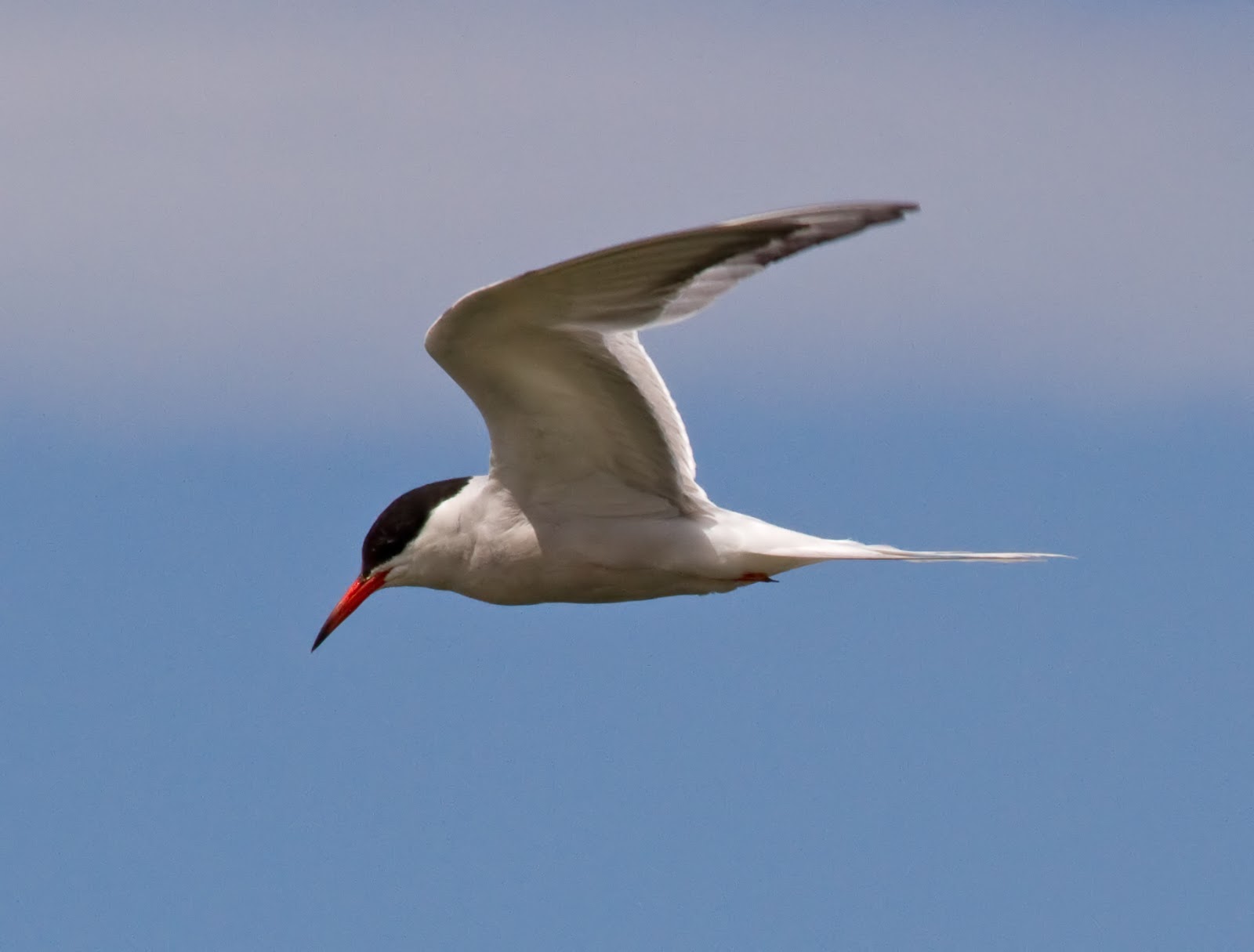
Sterna is a cosmopolitan genus of terns here restricted to species closely related to the common tern S. hirundo, though it has historically been used to cover the majority of tern species. Members of this genus in the restricted sense are mostly pale grey above with reddish bill and legs, and often have a black cap. The snowy-crowned tern S. trudeaui of South America is exceptional in having a white cap and yellow bill.
Jonathon Livingstone’s cousin
Published 14 April 2009

The terns are the gulls’ more refined relations. They have become superb aerialists, spending most of their lives on the wing, feeding on fish delicately plucked from the water’s surface as they fly above. Depending on where you look, the clade that the terns comprise may be dubbed the Sternini, Sterninae or Sternidae, but this is purely a quibble over ranking—there seems to be no disagreement about what is, or isn’t, a tern.
At the lower level (naturally), a little more disagreement ensues. There is a clear distinction between the mostly smaller, tree-nesting tropical noddy terns of the genera Anous, Gygis and Procelsterna (sometimes all combined in Anous) and the larger, ground-nesting true terns of Sterna and related genera. The spectacular cave-nesting Inca tern, Larosterna inca, also seems to be universally placed in its own genus. However, authorities differ on whether they would prefer to include all the ground-nesting terns in a single genus Sterna, or whether they would prefer to peel off some of the more distinctive taxa into what might be called Sterna‘s satellite genera, such as Hydroprogne caspia* (the Caspian tern), Chlidonias (the marsh terns) or Gelochelidon nilotica** (the gull-billed tern).
*Hydroprogne, as it happens, translates into English as “water swallow”, which seems a rather apropos description for any tern..
**As well as being morphologically distinct, Chlidonias and Gelochelidon (the “laughing swallow”) both differ from most other terns in being much more likely to be found inland. Here in Australia, Gelochelidon nilotica can travel almost to the centre of the continent, visiting temporary salt lakes when they are filled by the rains. There is something very surreal about being in the centre of the desert, hundreds of kilometres from the coast, and looking up to see terns passing overhead.

The only proper phylogenetic study that appears to have been published recently on terns was a mitochondrial DNA analysis by Bridge et al. (2005). Sternini were also included in the supertree analysis of Charadriiformes by Thomas et al. (2004), but a look through their source trees suggests that their data for Sternini were almost entirely derived from a 1984 PhD thesis. Bridge et al. (2005) found that Larosterna inca was nested well within Sterna sensu lato, and suggested the recognition of nine genera within this clade (including Larosterna) – as well as those already mentioned, these were Onychoprion for the brown-winged terns, Sternula for the little terns, Phaetusa simplex (the large-billed tern) and Thalasseus for the crested terns, with Sterna restricted to a group labelled the “typical black-capped terns”. Most of the genera recognised by Bridge et al. (2005) correspond to groups recognised previously on morphological grounds. The one arguable exception is, ironically enough, their Sterna sensu stricto, which also remained poorly supported in Bridge et al.‘s analysis, though a smaller core of species within Sterna was well-supported.

One interesting detail of Bridge et al.‘s results is how closely the proposed phylogeny correlates with patterns of breeding plumage coloration on the head (it is worth noting that the two exceptions, Sterna sumatrana and S. trudeaui, have breeding plumages similar to the non-breeding plumages of related species). On the other hand, the correlation drops significantly when one considers overall coloration. This is most obvious in the genus Chlidonias—the great similarity in the head views of Chlidonias species in the figure above disguises the fact that these four species vary from almost entirely black (Chlidonias niger) to mostly white with only the cap of the head black (Chlidonias hybrida)*. The main point is that while there is a common assumption that colour patterns are a priori of little use as characters for phylogenetic analysis because they are supposedly too evolutionarily labile, this is not necessarily the case. Some details of colour pattern may indeed be very variable and prone to homoplasy, others may prove to be evolutionarily very conservative (and what is labile in one clade might be conservative in another) – much as one might find in just about any other possible character complex.
*As an aside, a comparison of different sources suggests that there has been confusion over whether the genus Chlidonias is masculine or feminine (and hence what is the appropriate spelling for the species in this genus). According to David & Gosselin (2002), Chlidonias is masculine—hence C. niger, C. leucopterus and C. albostriatus, but C. hybrida, because in this case “hybrida” is a noun in apposition, not an adjective. Thanks are due to Alan Peterson’s Zoonomen page for clearing this up.
Systematics of Sterna
<==Sterna Linnaeus 1758CC10
    |--+--S. forsteriBKB15
    |  `--S. trudeauiBKB15
    `--+--*S. hirundo Linnaeus 1758CC10, BKB15, CC10
       |    |--S. h. hirundoCC10
       |    |--S. h. longipennis Nordmann 1835CC10
       |    |--S. h. minussensisHR96
       |    `--S. h. tibetana Saunders 1876CC10
       `--+--+--S. paradisaea Pontoppidan 1763BKB15, CC10 (see below for synonymy)
          |  |    |--S. p. paradisaeaS05
          |  |    `--S. ‘macrura’ antistrophaS05
          |  `--+--S. hirundinacea Lesson 1831BKB15, P04
          |     `--S. vittata Gmelin 1789BKB15, CC10
          |          |--S. v. vittataCC10
          |          |--S. v. georgiae Reichenow 1904PB96
          |          `--S. v. bethunei Travers 1896 (see below for synonymy)CC10
          `--+--S. sumatrana Raffles 1822BKB15, CC10
             `--+--S. dougallii Montagu 1813BKB15, WS48 [incl. S. roseaF17]
                |    |--S. d. dougalliiWS48
                |    |--S. d. bangsi Mathews 1912I92
                |    `--S. d. gracilis Gould 1845WS48
                `--S. striata Gmelin 1789BKB15, CC10 (see below for synonymy)

Sterna incertae sedis:
  S. acuticaudaJT12
  S. anglicaR87
  S. araneaJ23
  S. aurantiaJT12
  S. douglasiiS66
  S. fluviatilis Naum. 1819M01
  S. fuliginosa Gmelin 1789CC10
  S. galericulataS66
  S. grisea Horsfield 1821 [=Hydrochelidon leucoptera grisea]CC10
  S. lorataJT12
  S. melanauchen [=Onychoprion melanauchen]W66
  S. melanogaster [=S. melanogastra]S89
  S. obscura [incl. S. brunnea]F17
  S. panayensisS66
  S. parva Ellman 1861 (n. d.)CC10
  S. repressaJT12
  S. saundersiJT12 [=S. albifrons saundersiD72]
  S. seenaS89
  S. virgataJT12
  S. vulgaris Ellman 1861 (n. d.)CC10
Sterna paradisaea Pontoppidan 1763BKB15, CC10 [=S. paradisea (l. c.)CC10; incl. S. arctica Swainson & Richardson 1831S05, S. macrura Naumann 1819CC10]
Sterna striata Gmelin 1789BKB15, CC10 [incl. S. albifrons Peale 1848 non Pallas in Vroeg 1764CC10, S. atripes Ellman 1861CC10, S. striata aucklandorna Mathews 1929CC10, S. bethunei Buller 1896 non Travers 1896CC10, S. striata bethuneiCC10, S. striata christopheri Mathews 1912CC10, S. frontalis Gray 1845CC10, S. striata incerta Mathews 1912CC10, S. melanorhyncha Gould 1848 non Sternula melanorhyncha Lesson 1847CC10, S. striata melanorhynchaCC10, S. velox Gould 1843 non Cretzschmar 1827CC10, S. striata yorki Mathews 1914CC10]
Sterna vittata bethunei Travers 1896 [incl. S. vittata bollonsi Mathews & Iredale 1913, S. vittata macquariensis Falla 1937]CC10
*Type species of generic name indicated
References
Bridge, E. S., A. W. Jones & A. J. Baker. 2005. A phylogenetic framework for the terns (Sternini) inferred from mtDNA sequences: implications for taxonomy and plumage evolution. Molecular Phylogenetics and Evolution 35: 459–469.
[BKB15] Burleigh, J. G., R. T. Kimball & E. L. Braun. 2015. Building the avian tree of life using a large-scale, sparse supermatrix. Molecular Phylogenetics and Evolution 84: 53–63.
[CC10] Checklist Committee (OSNZ). 2010. Checklist of the Birds of New Zealand, Norfolk and Macquarie Islands, and the Ross Dependency, Antarctica 4th ed. Ornithological Society of New Zealand and Te Papa Press: Wellington.
David, N., & M. Gosselin. 2002. Gender agreement of avian species names. Bulletin of the British Ornithologists’ Club 122 (1): 14–49.
[D72] Dharmakumarsinhji, R. S. 1972. Extension of breeding range and other notes on blackshafted little tern (Sterna albifrons saundersi Hume). Journal of the Bombay Natural History Society 69 (2): 420–422.
[F17] Forster, T. 1817. A synoptical catalogue of British birds; intended to identify the species mentioned by different names in several catalogues already extant. Forming a book of reference to observations on British ornithology. Nichols, Son, and Bentley: London.
[HR96] Heather, B. D., & H. A. Robertson. 1996. The Field Guide to the Birds of New Zealand. Viking: Auckland.
[I92] Iwahashi, J. (ed.) 1992. Reddo Deeta Animaruzu: a pictorial of Japanese fauna facing extinction. JICC: Tokyo.
[J23] James, E. 1823. Account of an Expedition from Pittsburgh to the Rocky Mountains, performed in the years 1819 and ’20, by order of the Hon. J. C. Calhoun, sec’y of war: under the command of Major Stephen H. Long. From the notes of Major Long, Mr. T. Say, and other gentlemen of the exploring party vol. 1. H. C. Carey & I. Lea: Philadelphia.
[JT12] Jetz, W., G. H. Thomas, J. B. Joy, K. Hartmann & A. Ø. Mooers. 2012. The global diversity of birds in space and time. Nature 491: 444–448.
[M01] Madarász, J. 1901. Madarak [Vögel]. In: Horváth, G. (ed.) Zichy Jenő Gróf Harmadik Ázsiai Utazása [Dritte Asiatische Forschungsreise des Grafen Eugen Zichy] vol. 2. Zichy Jenő Gróf Harmadik Ázsiai Utazásának Állattani Eredményei [Zoologische Ergebnisse der Dritten Asiatischen Forschungsreise des Grafen Eugen Zichy] pp. 21–39. Victor Hornyánszky: Budapest, and Karl W. Hierseman: Leipzig.
[P04] Palma, R. L. 2004. Designation of a lectotype for Docophorus atlanticus Kellogg, 1914 (Insecta: Phthiraptera: Philopteridae). Tuhinga 15: 13–16.
[PB96] Palma, R. L., & S. C. Barker. 1996. Phthiraptera. In: Wells, A. (ed.) Zoological Catalogue of Australia vol. 26. Psocoptera, Phthiraptera, Thysanoptera pp. 81–247. CSIRO Publishing: Melbourne.
[R87] Ramsay, E. P. 1887. List of Western Australian birds collected by Mr. Cairn, and Mr. W. H. Boyer-Bower, at Derby and its vicinity, with remarks on the species. Proceedings of the Linnean Society of New South Wales, series 2, 1 (4): 1085–1100.
[S89] Salvadori, T. 1889. Viaggio di Leonardo Fea nella Birmania e nelle regioni vicine. XIX.—Uccelli raccolti nei Monti Carin a nord-est di Tounghoo, nel Pegù presso Rangoon e Tounghoo e nel Tenasserim presso Malewoon. Annali del Museo Civico di Storia Naturale di Genova, Serie 2a, 7: 369–438.
[S05] Schalow, H. 1905. Die Vögel der Arktis. In: Römer, F., & F. Schaudinn (eds) Fauna Arctica. Eine Zusammenstellun der arktischen Tierformen, mit besonder Berücksichtigung des Spitzbergen-Gebietes auf Grund der Ergebnisse der Deutschen Expedition in das Nördliche Eismeer im Jahre 1898 vol. 4 pp. 79–288. Gustav Fischer: Jena.
[S66] Schlegel, H. 1866. Communication from, on mammals and birds collected in Madagascar. Proceedings of the Zoological Society of London 1866: 419–426.
Thomas, G. H., M. A. Wills & T. Székely. 2004. A supertree approach to shorebird phylogeny. BMC Evolutionary Biology 4: 28.
[W66] Walden, A. 1866. Notes on birds collected in Tennasserim and in the Andaman Islands. Proceedings of the Zoological Society of London 1866: 537–556.
[WS48] Whittell, H. M., & D. L. Serventy. 1948. A systematic list of the birds of Western Australia. Public Library, Museum and Art Gallery of Western Australia, Special Publication 1: 1–126.