
Belongs within: Truncatelloidea.
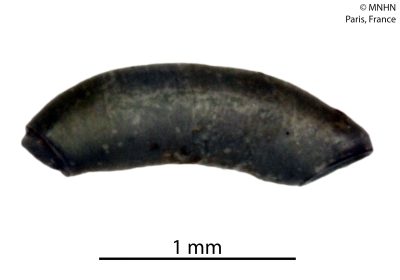
The Caecinae are small marine gastropods in which the mature shell is shaped as a slightly curved tube.
Stop giggling
Published 11 May 2009

It has to be admitted that some organisms have rather unfairly copped it when it comes to the names that biologists have chosen to bestow upon them. There are birds called Turdus and Arses, a beetle called Dermestes haemorrhoidalis, even the fungus Rectipilus doesn’t sound entirely comfortable. Compared to those unfortunates, today’s subject perhaps got off lightly. Still, I don’t think I would want to be known as Fartulum.
Fartulum is a taxon in the gastropod family Caecidae. Depending on where you look, it’s treated as either its own genus or a subgenus of the genus Caecum (ranking issues again, not really important). Species of Fartulum are distinguished from other species of Caecum or closely related genera by their combination of a cap-shaped apical plug (more on that in a moment) and perfectly smooth mature shell without the rings or ridges of other caecids.

Caecids are one of the more distinctive groups of gastropods. They belong to the superfamily Rissooidea, so are closely related to families with periwinkle-type shells such as Rissoidae and Hydrobiidae, but quite honestly you wouldn’t know it to look at them. Mind you, first you’d have to be looking at them, and not many people do that. Not because they’re uncommon, but because they’re tiny. Many would be pushing it to get past two millimetres. Even if you were sharp-sighted enough to spot a caecid, you might dismiss it as a fragment of something else. Caecids start out life as a flat-spiralling shell, but after a couple of turns the whorls open up and the caecid leaves its tight spiral (Carpenter, 1861). In Caecum and its subgenera or related genera, the growing gastropod then produces an apical plug with which it seals off the upper part of the shell, so the living animal is restricted to the anterior section. With no internal tissue holding it in place, the forsaken spire breaks off, so the mature caecid is a short, slightly curved tube, open at one end and plugged at the other (Carpenter, 1861, described Fartulum specimens as looking like “tiny sausages”). As the caecid continues to secrete new shell at the front, it draws forward the plug at the back and continues to shed old shell.
Caecids are detritivores, and live buried in marine sediment, or among sponges or algae. Despite their obscurity, they are far from uncommon. For instance, an ecological survey of the intertidal zone at Mazatlán Bay on the Pacific coast of Mexico by Olabarria et al. (2001) found Fartulum to be the most abundant deposit-feeder there by a fairly significant margin.
Further taxonomic eructations
Published 19 August 2024
It almost goes without saying that a group of animals like caecids would have a complicated taxonomic history. Their habit of shedding older sections of their shell means that specimens of different ages can look significantly different, whereas their overall simple configuration means that specimens of different species can look very similar. Many species are difficult to distinguish, and many names are now thought to be synonyms.
.jpeg)
An example of the challenges involved in classifying caecids is provided by Caecum laeve, the type species of the subgenus Fartulum. Caecum laeve is found along the Pacific coast of Central America, from Mexico to Panama. On the other side of the Isthmus of Panama is C. ryssotitum, found in the southern Caribbean and on the coast of Brazil. The two species are all but indistinguishable, the only consistent difference being that C. ryssotitum has the dorsal side of the shell slightly more bent towards the aperture end of the tube. Pizzini & Raines (2011) maintained the two as distinct species owing to their geographical separation. However, cases of a single species being found on both sides of the Isthmus are not unknown, and one does wonder whether these two populations are significantly distinct. Perhaps some form of genetic study would be necessary to settle the question. Things are not made simpler by the existence of C. bimarginatum, another near-identical species supposedly described from the region of Singapore. This species has not been re-discovered in that area, and Pizzini & Raines (2011) imply that they suspect the type specimen to have been mis-labelled.

Defolinia was established by Weisbord (1962) for Caecum tomaculum, a fossil species from the Late Cenozoic of Venezuela (Weisbord seems to have been unable to establish whether the exact age of the single type specimen was Miocene or Pliocene). Caecum tomaculum supposedly differed from Fartulum in its somewhat heavier, porcelaneous tube, and its apertural margin was thickened into a bevelled collar. Subsequent authors have not considered these differences significant enough to warrant subgenus status. Indeed, Absalão & Pizzini (2002) recommended that the use of subgenera within Caecum be dropped entirely. Not only is the relationship between subgeneric distinctions and evolutionary lineages questionable, but differences in appearance over the course of development may result in young individuals of a species being thought to belong to one subgenus, and more mature individuals being attributed to entirely another!
Systematics of Caecinae
<==CaecinaeBR05
    |--Meioceras Carpenter 1859AP02
    |    |--M. cornucopiae Carpenter 1859AP02
    |    |--M. cubitatum De Folin 1868AP02 [=Caecum (Meioceras) cubitatumAPS-P86]
    |    |--M. kajiyamai Habe 1963AP02
    |    |--M. nitidum Stimpson 1851AP02
    |    |--M. parvum (Adams 1852)AP02
    |    |--M. sandwichensis (Folin 1881) [=Caecum (Meioceras) sandwichensis]APS-P86
    |    |--M. subinflexum (Folin in Folin & Périer 1869) [=Caecum (Meioceras) subinflexum]APS-P86
    |    `--M. tenerum De Folin 1869AP02 [=Caecum tenerumAPS-P86]
    `--Caecum Fleming 1813BR05 (see below for synonymy)
         |--C. trachea (Montagu 1803)APS-P86 (see below for synonymy)
         |--C. abbreviatum Folin in Folin & Périer 1870 [=C. (Elephantulum) abbreviatum]APS-P86
         |--C. amputatum Hedley 1894 [=C. (Brochina) amputatum]APS-P86
         |--C. anellifer Pilsbry & Brown 1917W62
         |--C. angustum de Folin 1879W93
         |--C. armoricum Folin in Folin & Périer 1869 [=C. (Brochina) armoricum]APS-P86
         |--C. atlantidis Watson 1897AP02
         |--C. attenuatum Folin 1879 [=C. (Brochina) attenuatum]APS-P86
         |--C. auriculatum De Folin 1868AP02 [=C. (Brochina) auriculatumAP02; incl. Brochina chiereghiniana Brusina 1869APS-P86]
         |    |--C. a. auriculatumAP02
         |    `--C. a. decurtatumAP02
         |--‘Fartulum’ bakeri Bartsch 1920O27
         |--‘Micranellum’ barkleyense Bartsch 1920O27
         |--C. bicinctum Folin in Folin & Périer 1870 [=C. (Elephantulum) bicinctum]APS-P86
         |--C. bimamillatum Folin in Folin & Périer 1867 [=C. (Brochina) bimamillatum]APS-P86
         |--C. bipartitum De Folin 1870AP02
         |--C. brasilicum De Folin 1874AP02
         |--C. breve De Folin 1867AP02 [=[=C. (Elephantulum) breveAPS-P86]
         |--C. californicum Dall 1885 [=C. cooperi Carpenter 1864 non Smith 1862]O27
         |--C. carpenteri (Bartsch 1920)AP02 [=Elephantulum carpenteriO27, C. (Brochina) carpenteriAP02]
         |--‘Micranellum’ catalinense Bartsch 1920O27
         |--C. chilense Stuardo 1962APS-P86
         |--C. chinense Folin in Folin & Périer 1868 [=C. (Fartulum) chinense]APS-P86
         |--C. chipolanum Gardner 1947W62
         |--C. circumvolutum De Folin 1867AP02 [=C. (Brochina) circumvolutumAP02, C. (Fartulum) circumvolutumAPS-P86]
         |--C. clathratumC64
         |--C. clava Folin 1867 [=C. (Elephantulum) clava]APS-P86
         |--C. condylum (Moore 1969)AP02
         |--C. cooperi Smith 1862O27
         |--C. coronellum Dall 1892 [=C. (*Bambusum) coronellum]AP02
         |--C. crassicostum Gabb 1881W62
         |--C. crebricinctum Carpenter 1864 [=*Micranellum crebricinctum]O27
         |--C. curtatum De Folin 1867AP02
         |--C. cycloferum De Folin 1867AP02
         |--C. dalli Bartsch 1920O27
         |--C. dextroversum (Carpenter 1857) [=C. (Fartulum) dextroversum]AP02
         |--C. diegense Bartsch 1920O27
         |--C. digitulum Hedley 1804APS-P86 [=Caecum (Brochina) digitulumAPS-P86; incl. C. suteri Odhner 1924F27]
         |--C. diminutumAP02
         |--C. ‘eburneum’ de Folin 1879 non Adams 1852W93
         |--C. elegantissimum Carpenter 1858AP02
         |--C. eliezeri Absalão 1997AP02
         |--C. elongatum Carpenter 1857AP02
         |--C. exile Folin 1879 [=Caecum (Brochina) exile]APS-P86
         |--C. firmatum Adams 1852 [incl. C. eburneum Adams 1852, C. monstrosum Adams 1852, C. pygmaeum Adams 1852]APS-P86
         |--C. flemingi Gardner & Aldrich 1919W62
         |--C. floridanum Stimpson 1851W62
         |--C. glabrum (Montagu 1803)APS-P86 [=C. (Brochina) glabrumAPS-P86; incl. C. (*Armata) spinosumAP02]
         |--C. gracilis De Folin 1867AP02
         |--C. grippi Bartsch 1920O27
         |--‘Fartulum’ hemphilli Bartsch 1920O27
         |--C. heptagonum Carpenter 1857 [=C. (Elephantulum) heptagonum]AP02
         |--C. hexagonum [=C. (*Elephantulum) hexagonum]O27
         |--C. imbricatum Carpenter 1857AP02
         |--C. inclinatum Folin in Folin & Périer 1869 [=C. (Fartulum) inclinatum]APS-P86
         |--C. infimum Folin in Folin & Périer 1867 [=Caecum (Brochina) infimum]APS-P86
         |--C. insularum Moore 1970BC01
         |--C. jucundum De Folin 1867AP02
         |--C. laeve [=C. (*Fartulum) laeve]O27
         |--C. licalum Bartsch 1920O27
         |--C. lightfootae Pizzini, Nofroni & Oliverio 1994AP02
         |--C. lilianum Hedley 1903H09
         |--C. limnetes Long 1972 [=C. (Micranellum) limnetes]BC01
         |--C. limpidum Folin in Folin & Périer 1874 [=C. (Fartulum) limpidum]APS-P86
         |--C. lineicinctum De Folin 1879AP02
         |--C. liratocinctum Carpenter 1857 [incl. C. liratocinctum var. obsoletum, C. liratocinctum var. tenuiliratum]AP02
         |--C. malleatum Folin in Folin & Périer 1868 [=C. (Fartulum) malleatum]APS-P86
         |--C. marense Weisbord 1962W62
         |--C. massambabensis Absalão 1994 [=C. (Elephantulum) massambabensis]AP02
         |--C. mauritianum Folin in Folin & Périer 1868 [=C. (Fartulum) mauritianum]APS-P86
         |--C. microcyclos Folin 1879 [=C. (Fartulum) microcyclos]APS-P86
         |--C. modestum Folin in Folin & Périer 1868 [=C. (Fartulum) modestum]APS-P86
         |--‘Fartulum’ moorei Marincovich 1973BC01
         |--C. multicostatum De Folin 1867AP02
         |--‘Fartulum’ occidentale Bartsch 1920O27
         |--‘Fartulum’ orcutti Dall 1885O27
         |--‘Micranellum’ oregonense Bartsch 1920O27
         |--C. orientale Folin in Folin & Périer 1868 [=C. (Fartulum) orientale]APS-P86
         |--C. paradoxum Folin 1867APS-P86
         |--C. parvum Adams 1852APS-P86
         |--C. patuxentium Martin 1904W62
         |--‘Micranellum’ pedroense Bartsch 1920O27
         |--C. phronimum De Folin 1867AP02
         |--‘Micranellum’ profundicolum Bartsch 1920O27
         |--C. properegulare Mansfield 1925W62
         |--C. pulchellum Stimpson 1851W62
         |--C. puntagordanum Weisbord 1962W62
         |--C. putnamensis Mansfield 1924W62
         |--C. regulare Carpenter 1858W62
         |--‘Micranellum’ rosanum Bartsch 1920O27
         |--C. sardinianum Folin in Folin & Périer 1870 [=C. (Fartulum) sardinianum]APS-P86
         |--C. semilaeveC64
         |--C. senegambianum Folin in Folin & Périer 1870 [=C. (Fartulum) senegambianum]APS-P86
         |--C. sericeum Folin in Folin & Périer 1873APS-P86
         |--C. someri De Folin 1867 [=C. (Brochina) someri]AP02
         |--C. striatum Folin in Folin & Périer 1868 [=C. (Fartulum) striatum]APS-P86
         |--C. strigosum Folin in Folin & Périer 1868 [=Caecum (Brochina) strigosum]APS-P86
         |--C. subannulatum Folin in Folin & Périer 1870 [=Caecum (Brochina) subannulatum]APS-P86
         |--C. subflavum de Folin 1879H09
         |--C. subimpressumC64
         |--C. subornatum Folin in Folin & Périer 1874 [=Caecum (Brochina) subornatum]APS-P86
         |--C. subquadratum Carpenter 1858 [=C. (Fartulum) subquadratum]APS-P86
         |--C. succineum Folin 1879 [=C. (Fartulum) succineum]APS-P86
         |--C. syriacum Folin in Folin & Périer 1869 [=C. (Fartulum) syriacum]APS-P86
         |--C. textile Folin in Folin & Périer 1867 [incl. C. leptoglyphos Folin 1881]APS-P86
         |--C. tomaculum Weisbord 1962 [=C. (*Defolinia) tomaculum]W62
         |--C. tornatum Verrill & Bush 1900W62
         |--C. triornatum De Folin 1870AP02
         |--C. tripartitum De Folin 1870AP02
         |--C. uncinatum Folin 1867APS-P86
         |--C. undatumC64
         |--C. venezuelanum Weisbord 1962 [=C. (Fartulum) venezuelanum]W62
         |--C. venosum Folin in Folin & Périer 1867 [=C. (Fartulum) venosum]APS-P86
         |--C. vestitum Folin in Folin & Périer 1870 (see below for synonymy)APS-P86
         |--C. virginianum Meyer 1888W62
         `--C. warmi Raines & Pizzini 2009WBS-S15
Caecum Fleming 1813BR05 [incl. Anellum Carpenter 1875APS-P86, Armata Folin 1875APS-P86, Bambusum Olsson & Harbison 1954AP02, Brochina Gray 1857AP02, APS=P86, Brochus Brown 1827APS-P86, Caecalium Macgillivray 1843AP02, Cornuoides Brown 1827AP02, Defolinia Weisbord 1962APS-P86, Dentaliopsis Clarke in Gray 1850AP02, Elephantanellum Bartsch 1920APS-P86, Elephantulum Carpenter 1857AP02, APS-P86, Fartulum Carpenter 1857AP02, APS-P86, Laevia De Folin 1875AP02, Micranellum Bartsch 1920APS-P86, Odontidium Philippi 1836APS-P86, Odontina Zborzewsky 1834AP02, Odontostoma Cantraine 1835AP02, Quadrulata Folin 1867APS-P86]
Caecum trachea (Montagu 1803)APS-P86 [=Dentalium tracheaO27; incl. D. imperforatum Kanmacher 1978APS-P86, *Caecum imperforatumW93, Odontidium rugulosum (Philippi 1836)APS-P86, Brochus striatus Brown 1827APS-P86, B. trochiformis Brown 1827APS-P86]
Caecum vestitum Folin in Folin & Périer 1870 [=C. (Fartulum) vestitum; incl. C. buccina Folin 1870, C. carmenensis Folin 1870, C. veracruzanum Folin 1870]APS-P86
*Type species of generic name indicated
References
[AP02] Absalão, R. S., & M. Pizzini. 2002. Critical analysis of subgeneric taxa of the subfamily Caecinae (Caenogastropoda: Caecidae). Archiv für Molluskenkunde 131 (1–2): 167–183.
[APS-P86] Arnaud, P. M., Cl. Poizat & L. v. Salvini-Plawen. 1986. Marine-interstitial Gastropoda (including one freshwater interstitial species). In: Botosaneanu, L. (ed.) Stygofauna Mundi: A Faunistic, Distributional, and Ecological Synthesis of the World Fauna inhabiting Subterranean Waters (including the Marine Interstitial) pp. 153–176. E. J. Brill/Dr W. Backhuys: Leiden.
[BR05] Bouchet, P., & J.-P. Rocroi. 2005. Classification and nomenclator of gastropod families. Malacologia 47 (1–2): 1–397.
[BC01] Boyko, C. B., & J. R. Cordeiro. 2001. Catalog of Recent type specimens in the Division of Invertebrate Zoology, American Museum of Natural History. V. Mollusca, part 2 (class Gastropoda [exclusive of Opisthobranchia and Pulmonata], with supplements to Gastropoda [Opisthobranchia], and Bivalvia). Bulletin of the American Museum of Natural History 262: 1–170.
Carpenter, P. P. 1861. Lectures on Mollusca, or “Shell-fish” and their Allies. Prepared for the Smithsonian Institution. Congressional Globe Office: Washington.
[C64] Carpenter, P. P. 1864. Supplementary report on the present state of our knowledge with regard to the Mollusca of the west coast of North America. Report of the British Association for the Advancement of Science 33: 517–686.
[F27] Finlay, H. J. 1927. A further commentary on New Zealand molluscan systematics. Transactions and Proceedings of the New Zealand Institute 57: 320–485.
[H09] Hedley, C. 1909. The Marine Fauna of Queensland: Address by the President of Section D. Australasian Association for the Advancement of Science: Brisbane.
Olabarria, C., J. L. Carballo & C. Vega. 2001. Spatio-temporal changes in the trophic structure of rocky intertidal mollusc assemblages on a tropical shore. Ciencias Marinas 27 (2): 235–254.
[O27] Oldroyd, I. S. 1927. The Marine Shells of the West Coast of North America vol. 2 pt 3. Stanford University Press: Stanford University (California).
Pizzini, M., & B. Raines. 2011. The Caecidae from French Polynesia with description of eight new species (Caenogastropoda: Rissooidea). Bollettino Malacologico 47: 23–46.
[W62] Weisbord, N. E. 1962. Late Cenozoic gastropods from northern Venezuela. Bulletins of American Paleontology 62: 7–672.
[WBS-S15] Willan, R. C., C. Bryce & S. M. Slack-Smith. 2015. Kimberley marine biota. Historical data: molluscs. Records of the Western Australian Museum Supplement 84: 287–343.
[W93] Wilson, B. 1993. Australian Marine Shells vol. 1. Prosobranch Gastropods. Part One. Odyssey Publishing: Kallaroo (Western Australia).