
Belongs within: Panheteroptera.
Contains: Pyrrhocoroidea, Idiostoloidea, Coreidae, Alydidae.
The Coreoidea are a group of plant-feeding bugs, most species of which possess ocelli and a series of longitudinal accessory veins in the forewing membrane (Carver et al. 1991). Monophyly of the Coreoidea is uncertain though the clade may be supported by the presence of post-ocular tubercles, a deeply sulcate labial groove on the thoracic sternum, and connexivia partially covered by the fore wing (Yao et al. 2012).
Members of the Coreoidea include the Berytidae, stilt bugs, extremely slender and long-legged bugs characterised by short and spindle-shaped apical segments on the antennae. The Colobathristidae are also slender and long-legged (albeit not as remarkably so as the Berytidae) with narrow wings that have the venation on the membrane reduced or absent (Carver et al. 1991). The Malcidae are a small family with connexiva on abdominal segments 5 to 7 produced into conspicuous dentate lobes. A clade of Berytidae, Colobathristidae and Malcidae is supported by strongly developed sutures between the ocelli and compound eyes, antenniferous tubercles arising below the level of the eye and partially obscured by the mandibular plates, the fore wings and the base of the abdomen narrowed, and dorsally positioned spiracles II, III and IV (Yao et al. 2012).
The Hyocephalidae are a group of seed-eating bugs endemic to Australia characterised by the presence of ovoid, pore-bearing plates ventrolaterally at the base of the abdomen (Carver et al. 1991). The Rhopalidae have the fifth abdominal tergite constricted medially, and the scent-gland openings are slit-like or concealed (Richards & Davies 1977).
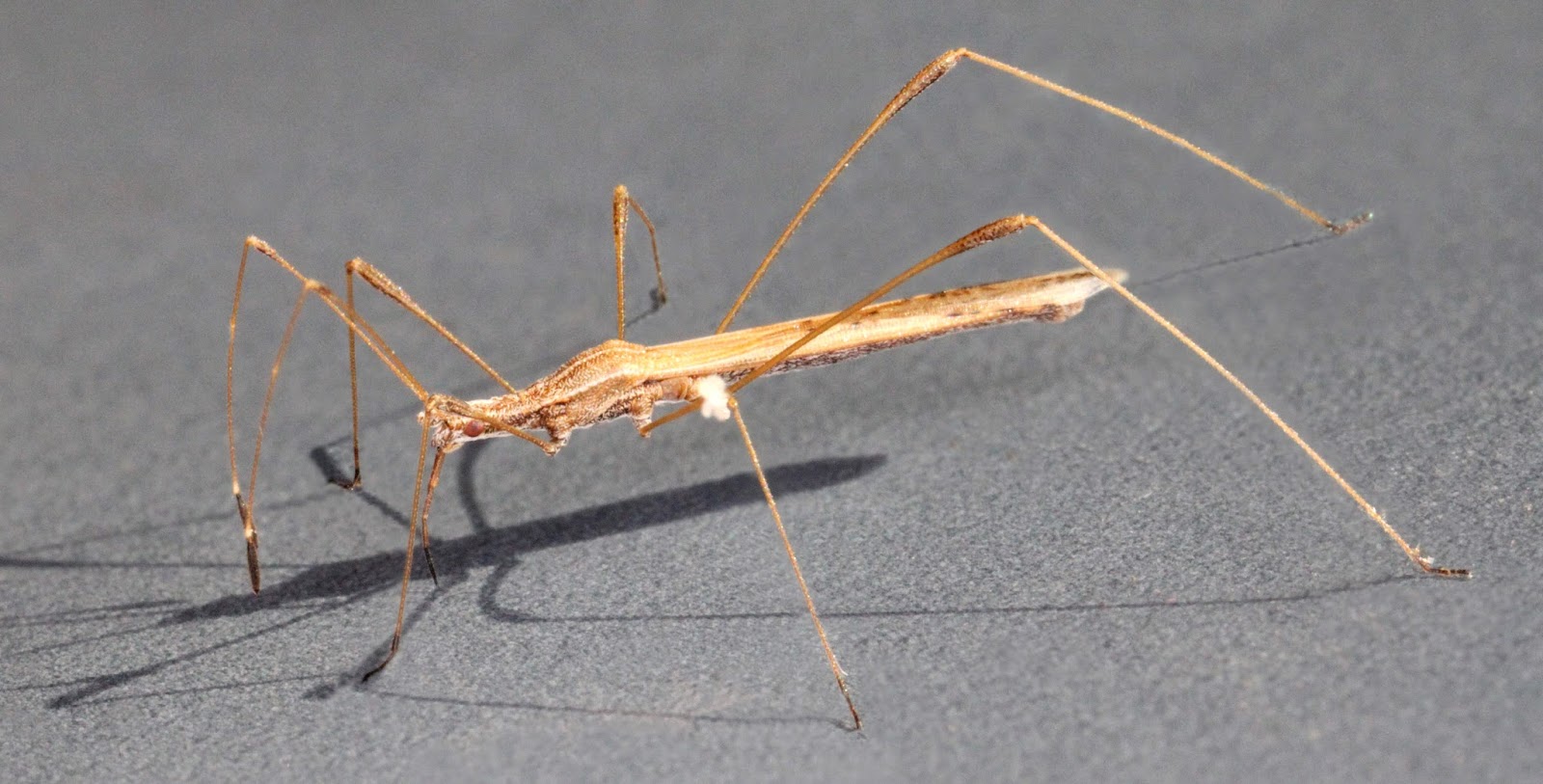
The stilt bug Neides tipularius
Published 15 March 2018
.jpg)
This is Neides tipularius, a widespread bug in the western part of the Palaearctic region. It feeds on a wide range of plants: I’ve seen references to it on grasses, on composites, or on chickweeds. It prefers drier regions such as coastal dunes or heaths.
Neides tipularius is a fairly typical member of the stilt bug family Berytidae. Berytids are more or less slender bugs in general but Neides is one of the more slender and long-legged ones. There are few other bugs with which a berytid could be confused; not only is there the wispy legginess to mark them, but berytids have distinctive long antennae with a short, spindle-shaped terminal segment forming a dark bobble at the end. Latreille (1802) did place N. tipularius in the genus Ploiaria, but that is now used for a group of small, long-legged assassin bugs with raptorial forelegs for catching prey.


As with many other bugs, Neides tipularius exhibits polymorphism in wing development with flightless brachypters having narrower wings that only just reach the tip of the abdomen. Whether a given individual grows into a flying or flightless adult appears to be connected to the conditions under which they develop. Hot springs and summers have been noted to lead to increased numbers of macropterous adults.
Systematics of Coreoidea
Characters (from Carver et al. 1991): Macropterous or brachypterous; brachypters with antennifers inserted dorsolaterally; ocelli present; membrane of hemelytron in macropters with at least 6 and usually many more longitudinal veins; S6 with 3 or fewer trichobothria on each side.
<==Coreoidea
    |  i. s.: Heterogastridae [Heterogastrinae]SE03
    |           |--DinomachusMC13
    |           |--Woodwardothignus gracilisCGW91
    |           `--Heterogaster Schilling 1829SE03
    |                |--H. salviaeL49
    |                `--H. urticae (Fabricius 1775)SE03 [=Lygaeus urticaeL49]
    |--+--ColobathristidaeYR12
    |  |    |--DayakiellinaeSP02
    |  |    `--Phaenacantha [Colobathristinae]CGW91
    |  |         |--P. australiaeCGW91
    |  |         |--P. pacifica Horváth 1904K08
    |  |         |--P. saccharicidaRD77
    |  |         `--P. viridipennisYR12
    |  `--+--Malcus [Malcidae]YR12
    |     |    `--M. setosusYR12
    |     `--Berytidae [Berytinae, Neididae]YR12
    |          |--Xenoloma Harris 1943H96
    |          |--Phaconotus Harris 1943H96
    |          |--Gampsocoris pulchellusYR12
    |          |--Protacanthus Uhler 1893D01
    |          |    `--P. haleiCGW91
    |          |--Diabolonotus Henry 1996H96
    |          |    `--*D. pilosus Henry 1996H96
    |          |--Oedalocanthus Henry 1996H96
    |          |    `--*O. ornatus Henry 1996H96
    |          |--Metacanthus Costa 1848D01
    |          |    |--M. decorus (Uhler 1893) [=Protacanthus decorus; incl. M. capitatus Uhler 1894]D01
    |          |    `--M. plutoCGW91
    |          |--BerytusH01
    |          |    |--B. annulatusL49
    |          |    |--B. clavipesH01
    |          |    `--B. elegans [=Neides elegans]L49
    |          `--NeidesCGW91
    |               |--N. clavipes [=Gerris clavipes]L02
    |               |--N. maipongaG75
    |               |--N. muticus [=Capys muticus]VD12
    |               |--N. propinquus Horváth 1901H01
    |               `--N. tipulariusH01 [=Gerris tipulariusL02]
    `--+--PyrrhocoroideaYR12
       `--+--IdiostoloideaYR12
          `--+--+--CoreidaeYR12
             |  `--AlydidaeYR12
             `--+--+--StenocephalidaeCGW91
                |  |    |--Dicranocephalus setulosusYR12
                |  |    `--Stenocephalus nugax [=Coreus nugax, Dicranomerus nugax, Lygaeus nugax]L49
                |  `--HyocephalidaeG75
                |       |--Hyocephalus aprugnusYR12
                |       `--Maevius indecorusCGW91
                `--RhopalidaeYR12
                     |--Liorhyssus hyalinusCGW91
                     |--Chorosoma macilentumRD77, H01
                     |--Miracorizus punctatusYR12
                     |--Longiclavula calvataYR12
                     |--Originicorizus pyriformisYR12
                     |--Quatlocellus liaeYR12
                     |--Grandicaputus bipunctatusYR12
                     |--MyrmusRD77
                     |    |--M. glabellus Horváth 1901H01
                     |    |--M. longiventrisH01
                     |    `--M. miriformisH01
                     |--RhopalusYR12
                     |    |--R. capitatus [=Coreus capitatus]L49
                     |    |--R. errans [=Coreus errans, Lygaeus errans, Myrmus errans]L49
                     |    |--R. latusYR12
                     |    `--R. pratensis [incl. R. parumpunctatus]L49
                     `--Leptocoris [Serinethinae]CGW91
                          |--L. augurK08
                          |--L. insularis Kirkaldy 1908K08
                          |--L. mitellatusCGW91
                          `--L. rufomarginatusCGW91
*Type species of generic name indicated
References
[CGW91] Carver, M., G. F. Gross & T. E. Woodward. 1991. Hemiptera (bugs, leafhoppers, cicadas, aphids, scale insects etc.) In: CSIRO. The Insects of Australia: A textbook for students and research workers 2nd ed. vol. 1 pp. 429–509. Melbourne University Press: Carlton (Victoria).
[D01] Distant, W. L. 1901. Rhynchotal notes.—IX. Heteroptera: fam. Coreidae. Annals and Magazine of Natural History, series 7, 7: 416–432.
[G75] Gross, G. F. 1975. Plant-feeding and Other Bugs (Hemiptera) of South Australia. Heteroptera—Part I. Handbook of the Flora and Fauna of South Australia.
[H96] Henry, T. J. 1996. Two new genera and two new species of New World stilt bugs (Heteroptera: Berytidae). Proceedings of the Entomological Society of Washington 98 (3): 533–540.
[H01] Horváth, G. 1901. Hemipterák [Hemiptera]. In: Horváth, G. (ed.) Zichy Jenő Gróf Harmadik Ázsiai Utazása [Dritte Asiatische Forschungsreise des Grafen Eugen Zichy] vol. 2. Zichy Jenő Gróf Harmadik Ázsiai Utazásának Állattani Eredményei [Zoologische Ergebnisse der Dritten Asiatischen Forschungsreise des Grafen Eugen Zichy] pp. 245–274. Victor Hornyánszky: Budapest, and Karl W. Hierseman: Leipzig.
[K08] Kirkaldy, G. W. 1908. A catalogue of the Hemiptera of Fiji. Proceedings of the Linnean Society of New South Wales 33: 345–391, pl. 4.
[L02] Latreille, P. A. 1802. Histoire Naturelle, générale et particulière des crustacés et des insectes vol. 3. Familles naturelles des genres. F. Dufart: Paris.
[L49] Lucas, H. 1849. Exploration Scientifique de l’Algérie pendant les années 1840, 1841, 1842 publiée par ordre du gouvernement et avec le concours d’une commission académique. Sciences physiques. Zoologie. II. Histoire naturelle des animaux articulés. Troisième partie. Insectes (suite). Imprimerie Nationale: Paris.
[MC13] Majer, J. D., S. K. Callan, K. Edwards, N. R. Gunawardene & C. K. Taylor. 2013. Baseline survey of the terrestrial invertebrate fauna of Barrow Island. Records of the Western Australian Museum Supplement 83: 13–112.
[RD77] Richards, O. W., & R. G. Davies. 1977. Imms’ General Textbook of Entomology 10th ed. vol. 2. Classification and Biology. Chapman and Hall: London.
[SE03] Scudder, G. G. E., & A. C. Eyles. 2003. Heterogaster urticae (Hemiptera: Heterogastridae), a new alien species and family to New Zealand. Weta 25: 8–13.
[SP02] Shcherbakov, D. E., & Yu. A. Popov. 2002. Superorder Cimicidea Laicharting, 1781: Order Hemiptera Linné, 1758. The bugs, cicadas, plantlice, scale insects, etc. [=Cimicida Laicharting, 1781, =Homoptera Leach, 1815+Heteroptera Latreille, 1810). In: Rasnitsyn, A. P., & D. L. J. Quicke (eds) History of Insects pp. 143–157. Kluwer Academic Publishers: Dordrecht.
[VD12] Van Duzee, E. P. 1912. Synonymy of the Provancher collection of Hemiptera. Canadian Entomologist 44 (11): 317–329.
[YR12] Yao, Y., D. Ren, D. A. Rider & W. Cai. 2012. Phylogeny of the infraorder Pentatomomorpha based on fossil and extant morphology, with description of a new fossil family from China. PLoS One 7 (5): e37289.