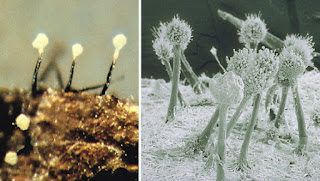
Belongs within: Diaporthomycetidae.
The Ophiostomatales are a group of fungi producing spores that are dispersed by associated insects; among the Ophiostomatales are many of the ambrosia fungi found in association with bark beetles.
Characters (from von Arx & van der Walt): Thin dikaryotic hyphae with septa with simple pores; small, evanescent asci in perithecial ascomata that usually have long beaks through which the ascospores are extruded as a sticky, mucoid mass; small, pale ascospores without germ pores, dispersed by associated insects.
Ophiostomatales
    |  i. s.: ‘Graphium’ albumJKW03
    |         ‘Phialocephala’ fuscaJC03
    |         ‘Phialocephala’ xalapensisJC03
    |--Kathistes Malloch & Blackw. 1990 [Kathistaceae]KC01
    |    |--K. analemmoidesHWB03
    |    `--K. clyculataHWB03
    `--OphiostomataceaeEB03
         |  i. s.: Klasterskya Petr. 1940KC01
         |         Spumatoria Massee & Salmon 1901KC01
         |         Subbaromyces Hesselt. 1953KC01
         |         Cornuvesica Viljoen, Wingf. & Jacobs 2000KC01
         |         Sporothrix Hektoen & Perkins 1901KC01
         |           |--S. albicansSL02
         |           `--S. schenckiiJKW03
         |--Ceratocystiopsis Upadhyay & Kendr. 1975HM17, KC01
         |    `--C. minutaHM17
         |--+--Fragosphaeria Shear 1923HM17, KC01
         |  |    `--F. purpureaHM17
         |  `--Raffaelea Arx & Hennebert 1965HM17, KC01
         |       `--R. canadensisHM17
         `--Ophiostoma Syd. & Syd. 1919HM17, KC01 (see below for synonymy)
              |--O. bicolorSL02
              |--O. francke-grossmanniaeJC03
              |--O. ipsSL02
              |--‘Leptographium’ lundbergiiJC03
              |--O. novoulmiSL02
              |--O. piliferumJC03
              |--O. quercusSL02
              |--O. stenocerasJKW03
              `--O. ulmi [=Graphium ulmi Schwarz 1922, Ceratocystis ulmi]SWW95
Ophiostoma Syd. & Syd. 1919HM17, KC01 [=Linostoma Höhn. 1918 non Wall. 1831KC01; incl. Europhium Parker 1957KC01, Graphilbum Upadhyay & Kendr. 1975KC01, Grosmannia Goid. 1936KC01, Hyalorhinocladiella Upadhyay & Kendr. 1975KC01, Knoxdaviesia Wingf., van Wyk & Marasas 1988KC01, Leptographium Lagerb. & Melin 1927KC01, Pesotum Crane & Schokn. 1973KC01]
*Type species of generic name indicated
References
[EB03] Eriksson, O. E., H. O. Barah, R. S. Currah, K. Hansen, C. P. Kurtzman, G. Rambold & T. Laessøe (eds.) 2003. Outline of Ascomycota—2003. Myconet 9: 1–89.
[HWB03] Henk, D. A., A. Weir & M. Blackwell. 2003. Laboulbeniopsis termitarius, an ectoparasite of termites newly recognized as a member of the Laboulbeniomycetes. Mycologia 95 (4): 561–564.
[HM17] Hongsanan, S., S. S. N. Maharachchikumbura, K. D. Hyde, M. C. Samarakoon, R. Jeewon, Q. Zhao, A. M. Al-Sadi & A. H. Bahkali. 2017. An updated phylogeny of Sordariomycetes based on phylogenetic and molecular clock evidence. Fungal Diversity 84: 25–41.
[JC03] Jacobs, A., M. P. A. Coetzee, B. D. Wingfield, K. Jacobs & M. J. Wingfield. 2003. Phylogenetic relationships among Phialocephala species and other ascomycetes. Mycologia 95 (4): 637–645.
[JKW03] Jacobs, K., T. Kirisits & M. J. Wingfield. 2003. Taxonomic re-evaluation of three related species of Graphium, based on morphology, ecology and phylogeny. Mycologia 95 (4): 714–727.
[KC01] Kirk, P. M., P. F. Cannon, J. C. David & J. A. Stalpers. 2001. Ainsworth & Bisby’s Dictionary of the Fungi 9th ed. CAB International: Wallingford (UK).
[SL02] Schweigkofler, W., K. Lopandic, O. Molnár & H. Prillinger. 2002. Analysis of phylogenetic relationships among Ascomycota with yeast phases using ribosomal DNA sequences and cell wall sugars. Organisms Diversity & Evolution 2: 1–17.
[SWW95] Seifert, K. A., B. D. Wingfield & M. J. Wingfield. 1995. A critique of DNA sequence analysis in the taxonomy of filamentous Ascomycetes and ascomycetous anamorphs. Canadian Journal of Botany 73 (Suppl. 1): S760–S767.