

Belongs within: Taxocrinida.
On Taxocrinus
Published 17 August 2019
Below is an example of Taxocrinus, a genus of fossil crinoids known from the later Devonian and earlier Carboniferous of Europe and North America. It is a relatively plesiomorphic representative of the flexible crinoids, one of the major crinoid lineages of the Palaeozoic era.
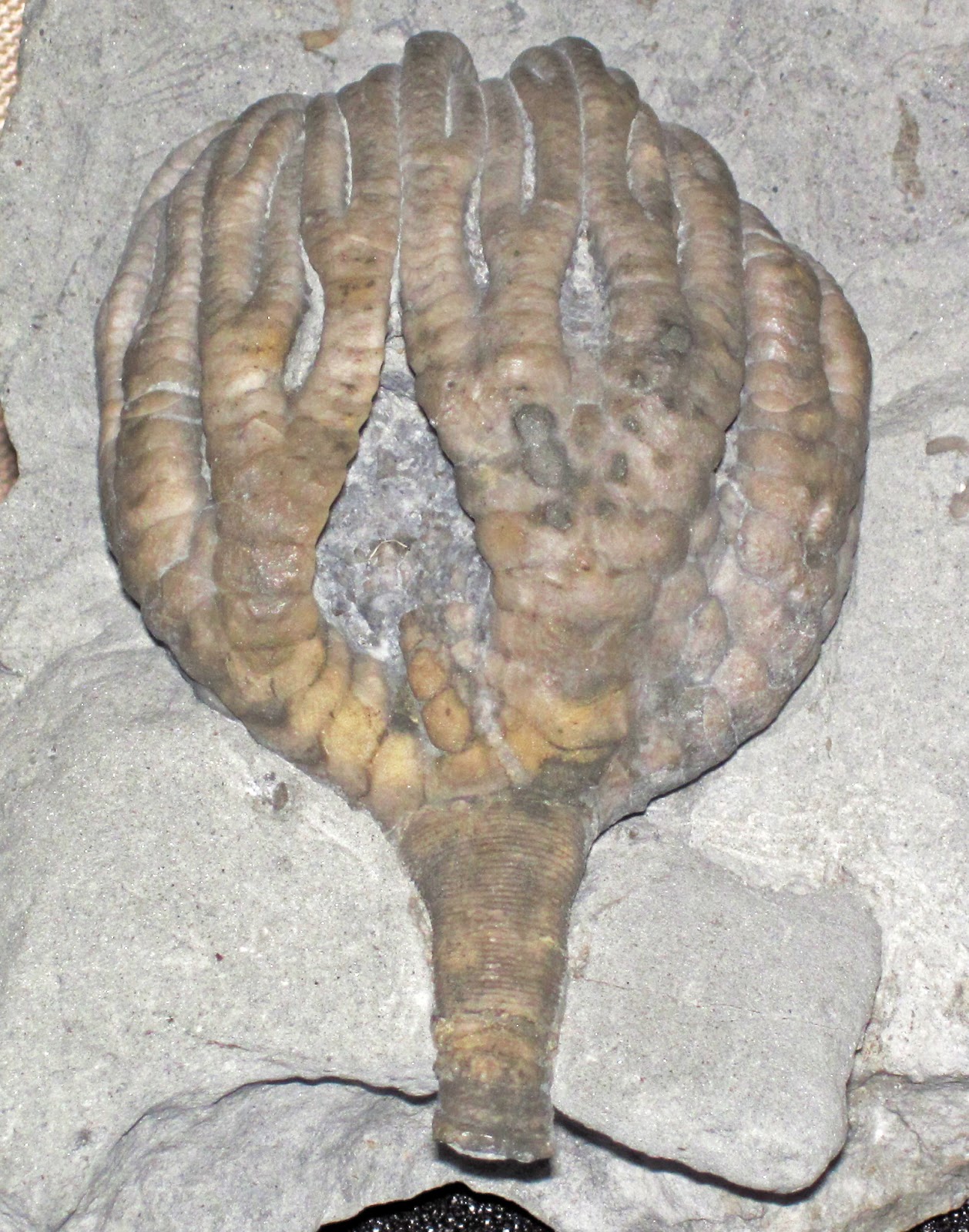
Flexible crinoids are characterised by arms that lack pinnules, the small side-branches found on the arms of most other crinoids. As a result, the preserved arms have a somewhat tentacle-like appearance, and are commonly preserved coiled in over the oral surface of the central cup. In Taxocrinus, the arms were regularly and isotomously bifurcated: that is, they divided between two branches of more or less equal size. The central cup itself in flexible crinoids was (somewhat counter-intuitively) quite inflexible, with the plates of the aboral surface firmly jointed together. The oral surface bore a more flexible covering of small plates, and an anal tube
(visible near the midline of the fossil above) directed waste away from the mouth. The stem was round in cross section and lacked lateral cirri (Moore 1978).
Flexible crinoids were around for a very long time but it is rare for them to be found in abundance. As such, they were probably specialised for particular habitats that were either uncommon or less likely to be preserved. It has been suggested that, because their pinnule-less arms would have been poorly suited for filtering particles from strong currents, flexible crinoids may have inhabited calm, low-energy waters (Breimer 1978) (though I do wonder if enlarged tube feet may have partially filled the role of pinnules; is it possible to estimate the size of the tube feet from the preserved skeleton?) Crinoids living in such habitats will often hold the arms in a bowl arrangement so they may capture particles settling from higher in the water column. In the case of the flexible crinoids, moving the arms in and out may have created local water movements to further draw such particles in.
Though Taxocrinus itself would disappear in the mid-Carboniferous, flexible crinoids as a whole would persist to the end of the Permian. In more derived forms, the branching of the arms was often unequal, with the smaller branches effectively replacing the missing pinnules. In the end, though, the specialised flexibles were yet another casualty of the end-Permian cataclysm that so shook the composition of life on this planet.
Systematics of Taxocrinus
Taxocrinus Phillips in Morris 1843WeM03 (see below for synonymy)
    |--*T. macrodactylus (Phillips 1841)LMW01 (see below for synonymy)
    |--T. anomalus Waters, Maples et al. 2003WaM03
    |--T. belgicus Springer 1920WH99
    |--T. colletti White 1881WA17
    |--‘Poteriocrinites’ egertoni Phillips 1836 [=*Cladocrinites egertoni, *Cladocrinus egertoni]M78
    |--T. intermediusM78
    |--T. juvenis (Hall 1861)WH99
    |--T. lobatus (Hall 1862)WeM03
    |--T. ornatusM78
    |--T. praestans Springer 1920WeM03
    |--T. quadribrachiatus Webster, Maples et al. 2003WeM03
    |--T. stultus Whidborne 1896LMW01
    |--T. telleri Springer 1920WH99
    `--T. ungula Miller & Gurley 1896WeM03
Taxocrinus Phillips in Morris 1843WeM03 [=Isocrinites Phillips 1841 non von Meyer 1836M78, Isocrinus Phillips 1841 non von Meyer 1837M78, Taxocrinites Steininger 1853M78; incl. Cladocrinites Austin & Austin 1843M78, Cladocrinus Morris 1843M78, Chladiocrinus (l. c.)M78, Euryalecrinus Austin & Austin 1846 (n. n.)M78, Euryalocrinus Delage & Hérouard 1904M78]
*Taxocrinus macrodactylus (Phillips 1841)LMW01 [=Cyathocrinus macrodactylusLMW01, Cladocrinites macrodactylusLMW01, *Isocrinites macrodactylusM78, *Isocrinus macrodactylus Phillips 1841M78, *Taxocrinites macrodactylusM78; incl. Isocrinus monodactylus Phillips 1841LMW01, Cladocrinites monodactylusLMW01, Cyathocrinus monodactylusLMW01]
*Type species of generic name indicated
References
Breimer, A. 1978. Autecology. In: Moore, R. C., & C. Teichert (eds) Treatise on Invertebrate Paleontology pt T. Echinodermata 2 vol. 1 pp. T331–T343. The Geological Society of America, Inc.: Boulder (Colorado), and The University of Kansas: Lawrence (Kansas).
[LMW01] Lane, N. G., C. G. Maples & J. A. Waters. 2001. Revision of Late Devonian (Famennian) and some Early Carboniferous (Tournaisian) crinoids and blastoids from the type Devonian area of north Devon. Palaeontology 44 (6): 1043–1080.
[M78] Moore, R. C. 1978. Flexibilia. In: Moore, R. C., & C. Teichert (eds) Treatise on Invertebrate Paleontology pt T. Echinodermata 2. Crinoidea vol. 2 pp. T759–T812. The Geological Society of America, Inc.: Boulder (Colorado), and The University of Kansas: Lawrence (Kansas).
[WaM03] Waters, J. A., C. G. Maples, N. G. Lane, S. Marcus, Liao Z.-T., Liu L., Hou H.-F. & Wang J.-X. 2003. A quadrupling of Famennian pelmatozoan diversity: new Late Devonian blastoids and crinoids from northwest China. Journal of Paleontology 77 (5): 922–948.
[WH99] Webster, G. D., D. J. Hafley, D. B. Blake & A. Glass. 1999. Crinoids and stelleroids (Echinodermata) from the Broken Rib Member, Dyer Formation (late Devonian, Famennian) of the White River Plateau, Colorado. Journal of Paleontology 73: 461–486.
[WeM03] Webster, G. D., C. G. Maples, R. Mawson & M. Dastanpour. 2003. A cladid-dominated Early Mississippian crinoid and conodont fauna from Kerman Province, Iran and revision of the glossocrinids and rhenocrinids. Journal of Paleontology 77 (Suppl. 3): 1–35.
[WA17] Wright, D. F., W. I. Ausich, S. R. Cole, M. E. Peter & E. C. Rhenberg. 2017. Phylogenetic taxonomy and classification of the Crinoidea (Echinodermata). Journal of Paleontology 91 (4): 829–846.