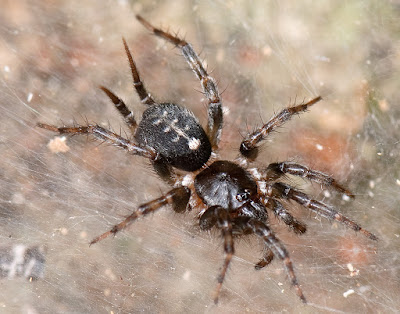
Belongs within: Avicularoidea.
The Dipluridae are a group of mygalomorph spiders that capture prey with a sheet web attached to a funnel-shaped retreat. They are distinguished by an extremely long, widely spaced pair of posterior spinnerets that extend well past the abdomen; the median spinnerets are much shorter but also widely spaced (Jocqué & Dippenaar-Schoeman 2007). Within the family, members of the subfamily Diplurinae have two rows of teeth on the paired claws of the legs; other subfamilies possess a single row of teeth.
Characters (from Jocqué & Dippenaar-Schoeman 2007): Small to large; cephalic region low; eight eyes present in a compact rectangular group; rastellum present, cheliceral furrow with two rows of strong teeth; legs with three tarsal claws; four spinnerets present, widely spaced, posterior pair very long.
<==Dipluridae
    |--EuagrusBS09 [EuagrinaeJD-S07]
    |    `--E. chisoseusBS09
    |--Ischnothele Ausserer 1875PCBFF08 [IschnothelinaeJD-S07]
    |    |--I. annulata Tullgren 1905FM11
    |    |--I. caudata Ausserer 1875PCBFF08
    |    |--I. guyanensisB06
    |    `--I. mashonica Pocock 1901P01
    |--Masteriinae [Masteriae]JD-S07
    |    |--Masteria hirsutaS89
    |    `--Accola Simon 1889S89
    |         |--A. lucifuga Simon 1889S89
    |         |--A. cyclops Simon 1889S89
    |         `--A. tovarensis Simon 1889S89
    `--DiplurinaeJD-S07
         |  i. s.: Clostes priscus Menge 1869S02
         |--Pseudatrax Rainbow 1914 [Pseudatraceae]R14
         |    `--*P. moreaui Rainbow 1914R14
         |--Poikilomorphia Rainbow 1914 [Poikilomorphiae]R14
         |    `--*P. montana Rainbow 1914R14
         |--BrachytheleaeR14
         |    |--Brachythele chinensis Kulczyński 1901R14, K01
         |    `--Euctimena Rainbow 1914R14
         |         `--*E. tibialis Rainbow 1914R14
         `--DipluraeS89
              |--UruchusS89
              |--Hapalothele Lenz 1885S89
              |--MitotheleS89
              |--HeterotheleS89
              |--Cethegus fugaxS89, M90 [=Palaevagrus fugaxM90]
              `--Diplura Koch 1850PCBFF08 [incl. Thalerothele Bertkau 1880S89]
                   |--D. bicolor Simon 1889S89
                   |--D. fasciata Bertkau 1880S89
                   `--D. soricina Simon 1889S89
Dipluridae incertae sedis:
  TrechonaeS89
    |--ThalerommataS89
    |--*Schismothele lineataS89
    `--Trechona Koch 1850 [incl. Eudiplura Simon 1892, Onysopelma Simon 1864, Pezionyx Simon 1864]PCBFF08
         |--T. rogenhoferi (Ausserer 1871) (n. d.) [=Diplura rogenhoferi, Eudiplura rogenhoferi]PCBFF08
         |--T. rufa Vellard 1924 [=T. venosa rufa]PCBFF08
         |--T. uniformis Mello-Leitão 1935PCBFF08
         `--T. venosa (Latreille 1832)PCBFF08
  Linothele Karsch 1879PCBFF08
    |--*L. curvitarsisS89
    |--L. megatheloides Paz & Platnick 1977PCBFF08
    `--L. sericata (Karsch 1879) [=Trechona sericata]PCBFF08
  AllotheleJD-S07
  Thelechoris karschiE95
  Microhexura montivagaE95
  NameaR95
  Microsteria sexoculataP92
*Type species of generic name indicated
References
[B06] Banks, N. 1906. Arachnida from the Bahamas. Bulletin of the American Museum of Natural History 22: 185–189.
[BS09] Blackledge, T. A., N. Scharff, J. A. Coddington, T. Szüts, J. W. Wenzel, C. Y. Hayashi & I. Agnarsson. 2009. Reconstructing web evolution and spider diversification in the molecular era. Proceedings of the National Academy of Sciences of the USA 106 (13): 5229–5234.
[E95] Elgar, M. A. 1995. The duration of copulation in spiders: comparative patterns. Records of the Western Australian Museum Supplement 52: 1–11.
[FM11] Freire-Jr, G. de B., & P. C. Motta. 2011. Effects of experimental fire regimes on the abundance and diversity of cursorial arachnids of Brazilian savannah (cerrado biome). Journal of Arachnology 39 (2): 263–272.
[JD-S07] Jocqué, R., & A. S. Dippenaar-Schoeman. 2007. Spider Families of the World. Royal Museum for Central Africa: Tervuren (Belgium).
[M90] Main, B. Y. 1990. Spiders of the Shark Bay area, Western Australia. In: Berry, P. F., S. D. Bradshaw & B. R. Wilson (eds) Research in Shark Bay: Report of the France-Australe Bicentenary Expedition Committee pp. 231–236. Western Australian Museum.
[PCBFF08] Pedroso, D. R., R. L. Cerqueira Baptista & P. S. Fiúza Ferreira. 2008. Trechona rufa (Araneae, Dipluridae): new status, redescription and neotype designation with notes on the genus. Journal of Arachnology 36 (2): 360–367.
[P01] Pocock, R. I. 1901. Diagnoses of some new species of spiders from Mashonaland. Annals and Magazine of Natural History, series 7, 7: 337–340.
[P92] Poinar, G. O., Jr. 1992. Life in Amber. Stanford University Press: Stanford.
[R14] Rainbow, W. J. 1914. Studies in Australian Araneidae, no. 6, the Terretelariae. Records of the Australian Museum 10 (8): 187–270.
[R95] Raven, R. J. 1995. Coxal glands of spiders of the genera Bymainiella, Atrax and Namea (Hexathelidae, Dipluridae, Mygalomorphae). Records of the Western Australian Museum Supplement 52: 67–71.
[S02] Selden, P. A. 2002. First British Mesozoic spider, from Cretaceous amber of the Isle of Wight, southern England. Palaeontology 45 (5): 973–983.
[S89] Simon, E. 1889. Voyage de M. E. Simon au Venezuela (Décembre 1887–Avril 1888). 4e mémoire. Arachnides. Annales de la Société Entomologique de France, 6e série 9: 169–220, pls 1–3.